Kathy Collins lets us know what not to say to a teacher. Go Kathy!
What Not To Say To A Teacher
5 Replies
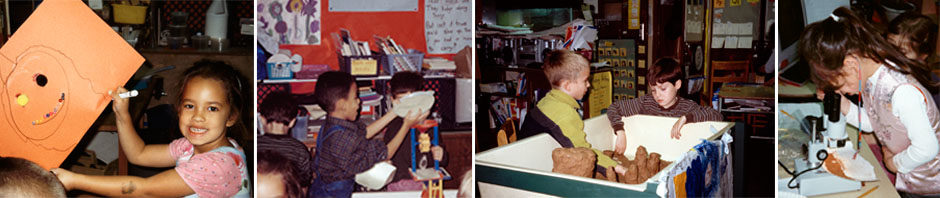
Kathy Collins lets us know what not to say to a teacher. Go Kathy!
 Frustration: a feeling of dissatisfaction, often accompanied by anxiety or depression, resulting from unfulfilled needs or unresolved problems.
Frustration: to balk or defeat in an endeavor; to induce feelings of discouragement, to make ineffectual: bring to nothing. To impede, obstruct or to make invalid or of no effect
My right arm has been in a cast since the morning of July 7th when I tripped on my front step and clumsily crashed onto the pavement. Being right-handed, this restriction on almost every little detail of daily life has been, to put it mildly, frustrating and often humiliating.
Lucky for me, this shall pass. In a few weeks the cast will come off and I’ll begin physical therapy. I’m hoping that my physical therapist will be endowed with a wealth of patience. I know from past experience that I am no “jock” and that my body does not bounce back quickly. I hope the physical therapist will work with me on my own playing ground. I hope that I don’t experience feelings of humiliation and failure by not meeting a generically expected timeline on my road to recovery.
My experience makes me think of young children and the Common Core Standards. Should each kindergarten child be expected to “Compose and decompose numbers from 11 to 19 into ten ones and some further ones, e.g., by using objects or drawings, and record each composition or decomposition by a drawing or equation (such as 18 = 10 + 8); understand that these numbers are composed of ten ones and one, two, three, four, five, six, seven, eight, or nine ones.” by the end of the school year?
What of the children who have different styles and rates of learning? Might we be creating an environment that leads to feelings of dissatisfaction, depression and anxiety for many children when we set a time-line, complete with a numerical rating of 1,2,3 and 4, for meeting standards that can be developmentally inappropriate expectations for all children to meet at the same time?
Don’t we want children (and adults going through physical therapy!) to feel supported and believed in? Isn’t it important that we let children, and their parents, know that we have confidence that they will “Read emergent-reader texts with purpose and understanding” and “Isolate and pronounce the initial, medial vowel, and final sounds (phonemes) in three-phoneme (consonant-vowel-consonant, or CVC) words” but not necessarily by a given date that has been selected by a group of people they have never met and who know nothing about each child’s particular likes, dislikes, strengths and challenges?
I know that, with time, practice, the support and encouragement of friends and family and the guidance of a patient, trained physical therapist, my hand will get strong again. It might take six months, a year or perhaps longer. But the diagnoses and expectation is that there will eventually be recovery.
Don’t we need to have similar expectations for children? We can and should have the high standards for children presented in the Common Core Standards without turning education away from the exciting challenge that it can be and into the frustrating race that it has become!

I could almost hear a chorus of silent groans coming from the teachers sitting around the table in the staff room at P.S. 10 in Brooklyn. It was March 17th, 2005, my first day working as a consultant at the school. The new principal, Jett Ritorto, wanted me to introduce inquiry projects and investigative Choice Time to the kindergarten teachers. But it was mid-March and this was just one more new addition to their already over-programmed day. I wasn’t welcomed with open arms!
“We can’t do an inquiry project. This is when we start our transportation unit.”
I recognized this plea from my own not-so-long-ago days in the classroom. I had my theme, my materials, and my time-schedule all set up and then, in would walk a new staff developer with her own agenda, turning all of my plans upside down.
I assured them that we would not be dropping the transportation unit. Instead we would see what happened if we approached it in a new way. I suggested that they each go on a neighborhood walk with their class that week, with a focus on exploring the different ways that people could travel, to, from, and around their neighborhood. After the walk, they should encourage children to share their observations. This would give the teachers a sense of what the students already know and also what form of transportation seemed to interest them the most. That would allow them to narrow the focus of the class’s transportation study.
When I came back to the school the next week, I met with each teacher individually. The inclusion team, Dana Roth and Karen Byrnes, were excited and eager to share their experience with me. Their children had lots of questions about the subway and that was where they wanted to focus their study. The three of us spent the rest of the period preparing an anticipatory web, plotting out the many possibilities for a subway study. All seemed well.
Later in the week they contacted me and sadly told me that a subway study was out of the question. One of the students was confined to a wheelchair and would have to be excluded from all subway trips. They decided to switch to a bus study. I suggested, however, that they first bring the problem to the class and see what kind of solution the children came up with.
The children were outraged! “That’s not fair! Saim should be able to go on the subway just like us!” Here began a most unusual transportation study – The Wheelchair Project.
The class decided to find out more about Saim’s wheelchair and what it was like for him to move around the school and neighborhood. Saim was pleased as punch to be the center of attention (Dana said that she would not have pursued this route if the child was sensitive about being singled out).
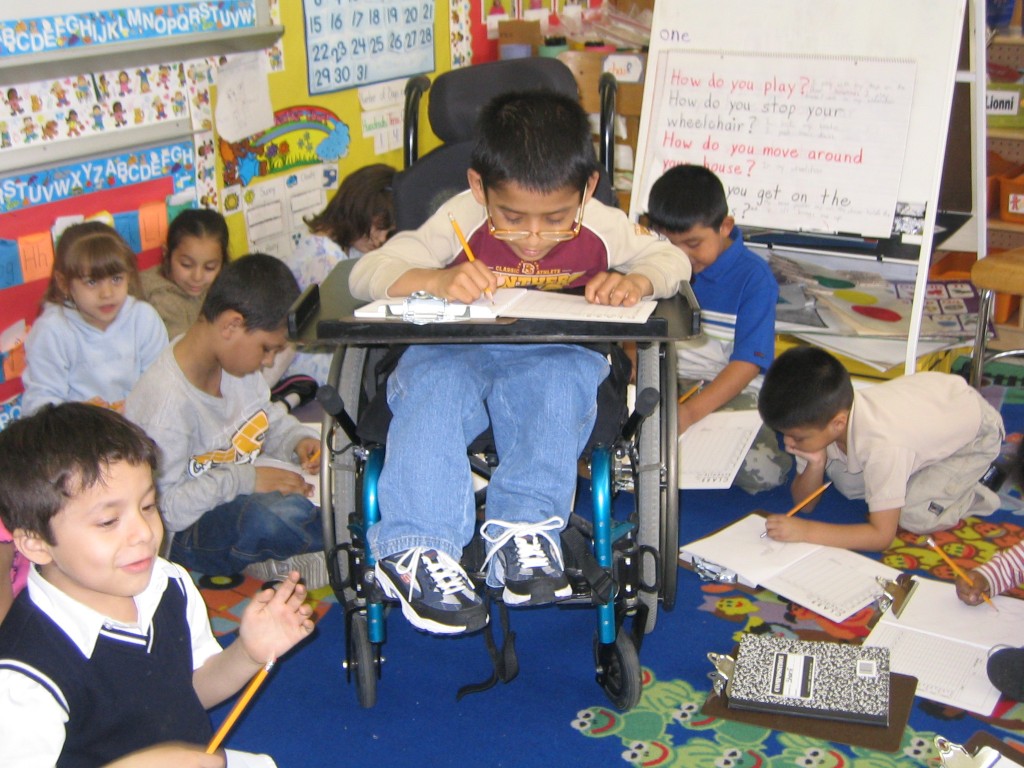
They began the study by interviewing Saim. After the interview, they all sat around him in a circle, observing and drawing. The teachers began webbing what children already knew about wheelchairs and also collecting their “wonderings” on post-its and adding these to the web. From these activities, they decided to focus their study on movement and accessibility. These were the two areas where the children had the most interest.
News about this unusual transportation study traveled around the school like hotcakes. When the school’s physical therapist heard about the investigation, she provided the class with an unused wheelchair. This became a very popular wheelchair observation center. Children used magnifying glasses, tape measures, and detail finders (a square of black paper with a peek-hole cut in the center) to look closely at the different parts of wheelchair. They drew the wheels, the brakes, and the gears. Then they shared their drawings and ‘recordings’ with the children in the block center who were constructing their own version of a wheelchair. This chair took many days to construct. It sometimes fell over and was rebuilt often and eventually was held together with yards of masking tape!


The class visited the school bus that brought Saim to school to see how the lift helped children with walkers and wheelchairs get on and off. They interviewed the driver and also met Manny, a very affable upper-grade child who used a walker to help him move about. Manny was invited to the classroom where he was interviewed. He then gave each child an opportunity to try out his walker.
After this experience, a lift-bus was built in the block center. After a few days, it was deconstructed and the children built “a better lift bus.”


They walked took neighborhood walks, checking to see which stores and sidewalks were “wheelchair friendly.” Then they walked around the school to find out if their school was wheelchair accessible. The front of the school had lots of steps! How did Saim get into school? In an exciting moment of discovery, they found the symbol that they saw on the lift bus, along with an arrow. The class followed the arrows until they came to the ramp entrance. Problem solved!

They visited a neighborhood house that had been altered to make it wheelchair accessible and they interviewed the owner of the building.
This study certainly held the interest of the class and raised a new awareness of the challenges in Saim’s daily life. The children developed a feeling of respect for Saim and for the other children in the school who used wheelchairs, walkers and crutches.
Over the years, I have returned to the school to visit Dana Roth and I’ve always been intrigued by the variety of studies taking place in her classroom. On one visit, the children were investigating colors – inventing colors, exploring the various names of Crayola crayons and coming up with their own inventive names for their newly mixed colors. On another visit, the children were building a school in their dramatic play center, reflecting their investigation of their own school. Dana still does some thematic studies but she also listens closely to her children and develops inquiry projects based on their interests and wonderings.
I haven’t worked at the school for the past five years, but I’m going back in the fall to, as Laura Scott, the new principal, says, “Give a refresher course” in inquiry studies to keep it alive and well at the school. Let’s see what happens.
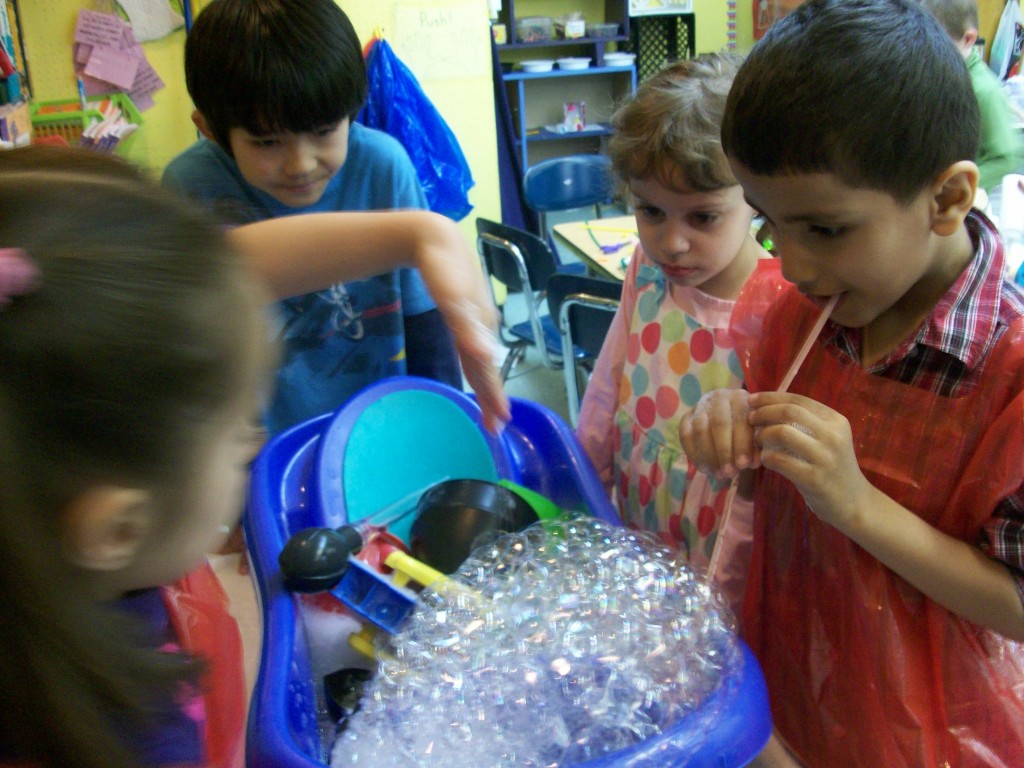
I just read this article by Amanda Moreno, the Associate Director of the Marsico Institute for Early Learning and Literacy. She speaks so well to many of my concerns, so I thought that I would share it with you. That isn’t to say that I am inagreement with every point. I do think that children learn through play although I do agree that play is not a strategy for stuffing knowledge into a child.
Read the article and share thoughts.
Killing Kindergarten
by Amanda Moreno, Ph.D
I want you to know it took a lot of self-discipline not to title this post “Killing Kindergarteners.” In addition to being an early education researcher, I am also a mother of a 5-year-old currently in kindergarten, so I can tell you that is pretty much the way it feels. All around this country, families are trying to figure out why their small children already dread going to a place that was supposed to serve as a gentle transition to formal learning. They are struggling with ambivalent allegiances, not wanting to be the over-protective parent who babies their child, but at the same time not being fully convinced that their child has a behavior problem just because they don’t enjoy sitting at a desk, independently going through worksheets for a solid hour.
It has become axiomatic in my field to say that early learning expectations are a full year ahead of what they were 20 years ago. Alfie Kohn points out an even more critical piece of this puzzle when he says that “The typical American kindergarten now resembles a really bad first-grade classroom” (italics mine). Somehow I don’t think Robert Fulghum’s list of essential lessons learned in kindergarten would have the same ring to it if among “share everything” and “play fair” appeared “100 sight words,” “command of capitalization and punctuation,” and “compose and decompose numbers 11-19.” Cynicism aside, a year’s worth of additional expectations isn’t in itself the biggest problem if you have a highly skilled teacher who can individualize to suit just about any learning style, and can make just about any learning task age-appropriate and engaging. That is a huge if, I would guess, according to most kindergarteners today.
Is teaching 5-year-olds really that complex an enterprise? It is true that little kids are like sponges in that they absorb discrete pieces of knowledge daily, naturally, and without effort, such as new vocabulary, locations of things in their house, how specific toys work, and what their family dinner and bedtime routines are. But in formal learning settings — at least as they are on average in the U.S. — the game completely changes. For better or worse, the “great divider” in formal learning settings may be whether the learner can decide to tackle new tasks or problems, not because she wants to but simply because she is being asked to. Is it OK for my 5-year-old to learn about Native American history and culture? Sure it is. The parts of the eye and inner ear — why not? But there is no intrinsic motivation when the lesson emphasizes the proper spelling “Tlingit” or “cochlea” and there never will be. No, the kindergarteners who do well with this kind of task are the ones who have already developed the ability to override their intrinsic motivation. This takes more than compliance — it takes executive function, which is in part attention and memory, and in part the ability to inhibit a pre-potent response. You know, like my daughter’s pre-potent response to color with the crayon that most attracts her eye, rather than limiting her choices to the browns, yellows, and oranges that were actually found in traditional Native American garb, as the curriculum required.
This sounds awful — like the only successful kindergartener is one with a broken spirit. It wouldn’t have to be this way if the educational system were structured to accommodate the natural, normal, and highly variable rates of development that occur in early childhood. All typically developing children acquire the basics of executive function eventually. So universal a finding across cultures is this, that it came to be known as the “5-to-7 year shift” — and it is the reason why formal schooling starts around this age worldwide. In this country, the word around makes all the difference. Given the range of ages at which children enter kindergarten (there is about a 25-month spread between the youngest and oldest students), and the three-year age range within which executive function skills begin to become more adult-like, children can be anywhere between preschool and third grade when the complex set of abilities required to decide to learn comes online sufficiently well. Even after controlling for age, kindergarteners still show greater variability in executive function than either fifth graders or preschoolers, indicating there is something unique about the cognitive reorganizations that take place during this period of life.
Our educational system is not equipped to support the application of this kind of knowledge. John Medina has said, “If you wanted to create an education environment that was directly opposed to what the brain was good at doing, you would probably design something like a classroom.”
In early childhood, when children are just beginning (and did I mention, at highly individualized rates?) to acquire the ability to focus under non-optimal circumstances and learn anyway, this is not only unproductive (as it is for learners of all ages), it is dangerous. For young children for whom intentional learning isn’t even on the radar screen yet, every day they spend sitting at a desk and filling out worksheets is like being in a foreign language immersion program with a teacher who believes they’re fluent.
This is not a debate about exploratory vs. direct instruction in the early grades, or play vs. structure, or creative learning vs. traditional academics, or any other label for this false dichotomy. Research supports both, depending on the group of children studied and methods used. While I staunchly believe that play is a human right, you don’t fix the misguided question of how to stuff knowledge into a 5-year-old’s brain simply by doing it “through play.” Similarly, when people tell you direct instruction “works,” ask them what it worked for. If the answer was standardized tests, then you merely have an unsurprising match between method and outcome. Either way, bad teaching will be the result if a kindergarten teacher practices (or is forced to practice) any style in the extreme, and without an arsenal of creative tools for individualizing to children. For those brilliant kindergarten teachers who do possess such a toolbox, the standards and testing craze has tamped their best instincts into hiding.
I agree with Holly Robinson who says that, from a parent’s perspective, the immediate answer lies in finding the right fit for your child — a process we are right in the middle of with our own daughter. Unfortunately, good options are not nearly plentiful enough, and those that exist are not accessible enough to families and children that likely need them the most. In the meantime, my colleagues and I are trying to do our part by speaking out for differentiating education reform efforts for young children, incorporating modern child and brain development principles into teacher and principal prep programs, and consulting to early education initiatives about how to answer to the pressures of accountability without “killing kindergarteners” in the process.

Nothing ever becomes real ’til it is experienced.
― John Keats
I recently had the pleasant experience of observing inquiry centers in Marta Quinones and Maureen Duffy’s inclusion first grade class at P.S. 142 in Manhattan.
This spring, they decided to begin an inquiry project focused on “My Fit and Healthy Body.” This investigation came out of Maureen’s particular interest in physical fitness and sports. The children were picking up on her enthusiasm for running and exercising. The teachers also hoped that this study might address some of the children’s poor eating habits.
The three of us began by brainstorming ideas for where this study might go.We created an anticipatory web, listing possible activities, trips, experts, reading and writing projects and math experiences.
The next step was to launch the study and to discover what the children already knew on the topic. Marta and Maureen began collecting the children’s initial questions or, as they called it, “wonderings”.
The questions flowed from the class! When they organized the post- its (small sticky-notes that the teachers used to record the students’ questions), the children and the teachers noticed was that there were many questions about bones. How do they break? Can they bend? How do they get fixed? How many do we have? How do we take care of them? Can they bend backwards? Do animals have the same bones as us? The questions were filling up the page of wonderings.
The direction of the study was now clear – finding out more about our bones!

On the morning of one of my school visits, I met with the two teachers for a planning meeting. I wanted to know what had happened since I was last there and what the teachers thought should be the “next steps” in the study. Marta noticed that a group of children were attempting to construct a model of a human skeleton in the block center. Their project, however, was becoming unfocused and chaotic. We discussed some possible strategies for supporting this project. We thought that they might take some time to look at and discuss anatomical illustrations with the children. Perhaps, after looking at the drawings, they might want to create a ‘blueprint’ on mural paper for their block skelton. Marta thought that she would give this suggestion a try. Maureen planned on looking at xrays with a group of children. |
Later in the day, I visited the classroom during Inquiry Center time. The children in the block center were working on their blueprint. They were using a foam rubber life-sized skeleton puzzle as a model for their construction. They also used a ruler to assist them in measuring unit blocks. The wanted to determine which block would match the size of the puzzle piece. They wanted it to be just the right size for their block skeleton.
As I sat on the side, observing, I was struck by the children’s collaboration and also by Marta’s calm, non-intrusive support of their work.
To my delight, I witnessed an unexpected example of children making an important discovery – Piaget’s theory about the conservation of matter! We often assume that children understand numerical consistency. Young children, however, don’t always understand that five blocks arranged side by side will be just the same size as five blocks stacked vertically. In this little video clip from Marta and Maureen’s classroom, though, we can see how important a discovery it is that 11 inches stays the same, horizontally AND vertically!
We have closed the list to participate in the October 23 -26, 2012 study tour to registration. Fifty eight (possibly sixty) educators have signed on! Now we are adding names to a waiting list.
It’s going to be quite an exciting experience, I’m sure. There will be a lot to write about on the blog!
 My former colleague, Liz Phillips, the principal of P.S. 321, Park Slope, Brooklyn, wrote this important letter to the commissionner of education in New York State. It’s a must read. Your thoughts will be shared with her if you like.
October 2012 Study Group for Literacy Educators
Loris Malaguzzi International Center
REGGIO EMILIA, ITALY
October 23- 26, 2012
Matt Glover and I have been working over the past two years to secure a study tour to the schools in Reggio Emilia, Italy.
THERE ARE STILL PLACES OPEN IN OUR GROUP. HOWEVER WE NEED TO SEND IN THE FINAL NUMBERS BEFORE THE END OF APRIL.
Matt and I share an interest in philosophies inspired by the educators in Reggio Emilia as well as effective practices in early literacy. We often feel like we have one foot in the world of effective literacy learning and one foot in the world of Reggio inspired practices. As we wrote in our study tour proposal:
“With one foot in each world, we have seen connections and bridges between these worlds that many educators miss. We read books by Katie Wood Ray and Ellin Keene and write “Reggio” in the columns constantly, even though Reggio Emilia is never explicitly mentioned. We visit schools like the Center For Inquiry in Columbia, South Carolina and The Brooklyn New School and see connections to the schools we’ve visited in Reggio Emilia, even though many of those teachers have never been to Reggio. We listen to literacy educators like Peter Johnston talk about interactions between children
and adults that are reflective of experiences at La Villetta watching Giovanni Piazza talk with children.
The goal of this proposed study tour is to create a bridge between these two worlds. We want to take some of the most passionate thinkers about children and literacy in the United States to Reggio Emilia so that they can see the connections between Reggio and their own work. Our hope is that the impact this study tour has on participants, and their subsequent writing, will be a force for positive change in education of the United States. ” Both of our visits to Reggio Emilia resonate in our work today.
PLEASE CONTACT ME ASAP IF YOU ARE INTERESTED IN JOINING THE GROUP AND/OR IF YOU NEED MORE INFORMATION.
HERE IS A LIST OF THE PARTICIPANTS, AS OF TODAY, APRIL 17th:
Kathy Collins
Heidi Mills
Peter Johnston
Vicki Vinton
Leah Mermelstein
Andrea Lowenkopf
Michelle Boden White
Anna Allanbrook
Mary Baldwin
Teresa Belisle
Mi Benson
Renée Dinnerstein
Amy Donnelly
Matt Glover
Ben Hart
Madeline Heide
SallyAnn Jeffreys
Stephanie Jones
Maya Nelson
Patti Pinciotti
Heather Radar
Rachel Schwartzman
Ena Shelley
Mary Lisa Vertuca
Steve Wilson
Teresa Young
Susan Adamson
Debbie Corpus
Anna Jaross
Susan Mitchell
Cynthia Merrill
Study Group Program Highlights
• Workshops and discussions groups
with a focus on extending many of the basic understandings and practices to grades beyond the preschool grades.
• Sharing experiences among participants
• Presentations by pedagogistas, atelieristas and teachers on the identity, aims and principles of the educational project
• Presentation and analysis of research projects realized inside the Preschools
• Visits to the Preschools
• Time at the Loris Malaguzzi International Center to see the current exhibitions and ateliers, and to visit the Documentation and Educational Research Center
• Visits within the city of Reggio Emilia encountering the town community
Daily Schedule
The days are full. Typically we will begin at 8:30 or 9:00 a.m. and end between 5:30 and
7:30 p.m. with a lunch break midday. Some evening options will be scheduled as well. The
organization of the days gives visibility to the values of the philosophy through a combination of center visits, plenary sessions, presentations, discussion groups and exchange of experiences between the participants and the pedagogistas, teachers and parents of the Reggio experience.
International Meeting Place
The venue for the study group is the Loris Malaguzzi International Center Loris Malaguzzi, which opened in February 2006 and has recently been completed. As described by Carlina Rinaldi, Pedagogista and President of Reggio Children, “It was created to give greater value to a strong and distinctive characteristic of Reggio Emilia; the ability to lend listening, visibility and support to the rights and requests of children, young people, families and teachers. The Center is a dedicated meeting place where professional development and research intersect for people in Reggio Emilia, Italy and the world who wish to innovate education and culture.”
Prior Preparation
Participants should be familiar with the history and fundamental principles of the Reggio Emilia approach to education so that they have some contextual framework before being immersed in the actual experience. Recommended readings are posted on the Articles page in the Print & Video Resources section of the North American Reggio Emilia Alliance (NAREA) website: www.reggioalliance.org. A general bibliography is posted in this section as well. Prior study group participants as well as first time visitors are welcome to attend.
Cost per person; $1,520
The Study Group cost includes the participation fee to Reggio Children and services provided by Angela Ferrario and International Study Tours, LLC. It does not include airfare or hotel accommodations.(hotel list attached with special rates for participants)
Participants are responsible for their own meals and for booking their flights and hotel.
Participation Fee to Reggio Children S.r.l. includes:
– The organization and presentation of the study group program for the week
– An informational folder for each participant with materials about the town of Reggio Emilia, its municipal infant-toddler center and preschools, Reggio Children, and the Loris Malaguzzi International Center
– Private bus transportation to and from the centers in Reggio Emilia when required by the program
– Professional interpreters when required by the program
– Insurance as specified in Responsibility clause below
– Refreshments during coffee breaks each day
Services provided by Angela Ferrario and International Study Tours, LLC include:
– Coordination of registration process and study group experience to support professional development, collaboration and collegiality among participants
– Facilitation of communication between study group organizers and colleagues at International Office of Reggio Children
– Compilation of participants’ brief professional narratives into a document that is distributed to the group and to Reggio Children
– Availability to participants by phone and email prior to departure
– Credit card services and foreign currency transfers
Hotel Information
Hotel Posta <info@hotelposta.re.it> (annex)
Single room Eur 58.00($77.33)
Double/Twin room Eur 87.00($115.99)
The rates are per room per night and inclusive of taxes and breakfast served at Hotel Posta (we are the Annex of this Hotel)
————————————————————————————————–
Hotel Posta
Piazza del Monte, 2
tel +39 0522 – 432944
fax +39 0522 – 452602
Single room Eur79.00($105.32)
– Double for shared occupancy Eur. 99.00(131.99)
– Rates are meant er room per night and include taxes and buffet continental breakfast
tel +39 0522 – 432944
fax +39 0522 – 452602
———————————————————————————
Albergo Delle Notarie <notarie@albergonotarie.it>
twin room (2 beds) (single) ($93.32)and 105.00 (twin) ($139.99)breakfast included.
————————————————————————————–
Albergo Morandi <info@albergomorandi.com>
– single room 64.00 €($83.32)
– double room 95.00 €($126.65)
Buffet breakfast, a free service of cafteria during the day, wi-fi and garage are included.
—————————————————————————————————-
Hotel San Marco
1 Single Room wiht breakfast included per room per night($66.66)
1 Double Room (2 Beds) with breakfast included per night ($99.99)
—————————————————————————————–
HOTEL EUROPA <info@hoteleuropa.re.it>
– One single room 87,00 euro($115.99) per night
– Twin room 107,00 euro ($142.65)per night
– International breakfast
– Internet Connection WIFI
– Parking / Garage
Tel. +39 0522-432323
Fax. +39 0522-432442
———————————————————————————————
ASTORIA REGGIO EMILI
1 Single Standard room 1 person BB (Bed & Breakfast)
($106.66) per room per night
1 Twin bedded room 2 persons BB (Bed & Breakfast)
($113.32)per room per night
Rate are including breakfast, outside parking, Fitness room, newspaper and Internet Acces from the room.
We offer three choice of breakfast:
Breakfast “GRAND REGAL” : a buffet breakfast with the kind of choice that’s bound
to please.
Italian Breakfast ” Coffee&Croissants“: quick and friendly, coffee and pastry at the bar.
With supplement: Breakast “Dolce risveglio” : 15,00 per person, the comfort of a breakfast in bed. Wake up in your time with
 “…stand aside for awhile and leave room for learning,
observe carefully what children do, and then, if you
have understood well, perhaps teaching will be
different from before.”
Louis Malaguzzi (Edwards, Gandini, Forman, 1995)
Some years ago, my daughter visited my kindergarten classroom during Choice Time. As she looked around the room, she observed the children at their various activities. One group was setting up a pretend doctor’s office in the dramatic play corner. At the art center, children were constructing spaceships from toilet paper rolls and egg cartons.  Four children, wearing plastic goggles, were using screwdrivers and pliers to take apart a broken telephone; two children were busy at the water table constructing a water machine with plastic tubing and funnels. Simone seemed fascinated by the life of the classroom.
“Whenever I come into your class at Choice Time, I feel like I’m walking into The King of Hearts she said, referring to a wonderfully magical film, a family favorite. The story takes place in a small French village during the First World War. After hearing news of an oncoming invasion, the villagers quickly fled to the countryside, accidentally leaving the gates of the town asylum unlocked. The innocent residents walk around the empty town in a state of wonder and amazement. They take over the jobs of the absent villagers, understanding some aspects of each role, but adding their own, highly serious, sometimes comical, interpretations as they attempted to recreate life in the outside world.
Kindergarten children are also filled with a sense of wonder and amazement. When they have the opportunity to self-direct their activities at Choice Time, they are attempting to make sense of the adult world. If we listen closely to their conversations and monologues, we can become privy to many of their understandings, misunderstandings, and questions.
Four children have transformed the Pretend Center into a doctor’s office. The wooden play stove, now covered with white paper, is the examining table. Placing her baby doll on the table, Elena, a bubbly five-year old dressed up in silver high-heels and my daughter’s outgrown fancy party dress, wails, “My baby is dead.” Jeffrey, now the ‘doctor,’ dressed in an oversized white shirt with a stethoscope dangling from his neck, takes rapid notes on a pad. “Don’t worry, I’ll fix the baby.” Jeffrey, taking a needle from the play doctor’s kit, jabs the baby’s arm. “O.K. now. The baby’s not dead anymore.” Elena picks up her baby, hands over a wad of play money from the pocketbook draped over her shoulder, and happily teeters away, balancing herself on her high-heeled shoes. In the block center, Luca has enclosed Karl inside what looks like a house without doors. Each time Karl’s arm reaches out, a wooden block falls down and Luca quickly replaces it. Then he runs to our reading nook, where we have a collection of stuffed animals. Selecting one, he returns to his construction, passing a stuffed animal to Karl. I observe this happening again a few minutes later. Each time Karl’s arm comes out and a block falls down, Luca replaces it adding another animal to Karl’s growing collection. Curious about this, I ask Luca about his building. “Karl is in jail, but don’t be worried. I bring him toys so he won’t be scared.”
Unfortunately, Luca’s father is in jail. Luca doesn’t ever speak about this. Not with me. Not with his friends. Not with his mother. He keeps his feeling hidden deep inside. Somehow, in his play with Karl, he found a safe outlet for expressing his fears and concerns. He found a way to make the experience of being incarcerated safe for his father and less threatening for himself.
Choice Time is Playtime. Playtime is Work time!
The children think of the hour in the day that I call Choice Time, as their playtime, I know that it is so much more. When I plan centers, I keep in mind these big goals: children should develop independence and self-confidence; centers should be ‘open’ enough to allow for children making interdisciplinary connections and developing personal inquiries; opportunities for using reading, writing and mathematics for natural and authentic purposes should be available in each center; the activities should allow children to work out social conflicts within a safe, protective environment and support their ability for developing positive social skills.
A high-standards kindergarten curriculum, should include opportunities for children to develop reading and writing skills. These are sometimes taught using the structure of reading and writing workshops. There’s time for word study, read – aloud , and mathematical instruction. There should be many opportunities for whole-class and small group discussions on a variety of topics. These can be from teacher or child generated ideas.
When we develop a classroom that encourages inquiry and exploration, we empower children, giving them skills they will use throughout their lives. When we plan Choice Time with this same philosophy and intent, we open up opportunities for helping children to grow socially and intellectually. This can occur when we encourage children to find ways of recording and sharing their discoveries at the sand table, write messages to each other in a class post office, label their art work, put up important signs by their block buildings, write a recipe for making playdough or make new jackets for their favorite storybooks. If children are making Valentine’s Day cards at a center, merely by attaching writing paper to the cards, we extend the activity in a way that says, “here’s where I will write my message.” If we celebrate, display and share the exciting moments and products of Choice Time play/work we’re sending to children, families and administration a loud and clear message about the importance that we place on exploration, inquiry and, yes, play, in the life of a five year old child!
Shelly Kee, Shelly Kee Bookey
Put out all your horns,
All the ladies are coming to see you*
*Irish children’s chant – you can hear it on iTunes: http://itunes.apple.com/us/album/so-early-in-morning-irish/id162653706
(you can hear the chant if you click on the link and then click on Shelly Kee Bookey!)

All children seem to love playgrounds. They don’t need instruction on what to do with climbing bars, swings, a sandbox or a crawling tunnel. They run right off to play.
It’s not unusual to see children become fascinated with a ladybug crawling across a branch, an ant working its way over a fence or a caterpillar inching itself through the grass.
Children are naturally curious and full of energy.
So what happens in a kindergarten class where children who are studying playgrounds are introduced to a tankful of snails in their science center?
A playground for the snails!
Of course this magical combination of a snail study and playground study needs some special conditions to allow this idea to take shape. It needs children who have had opportunities to visit and play in many playgrounds. These children need to have had the time and encouragement to freely observe and explore snails in their science center. There should have been many experiences for children to use their imagination as they worked with a variety of open-ended art materials. AND, quite importantly, there needs to be a teacher who values exploration, inquiry, play and imagination.
You will find all of these ingredients in Bill Fulbrecht’s kindergarten class at P.S. 321 in Brooklyn, New York.
When I visited during Choice Time this week, the children were in the midst of the playground study that began even before the start of the school year. During the summer Bill sent out a letter letting the children know that they were all going to become playground experts that year! He encouraged the children to bring in, on their first day of school, drawings and pictures of playgrounds. The seed for the study was planted!
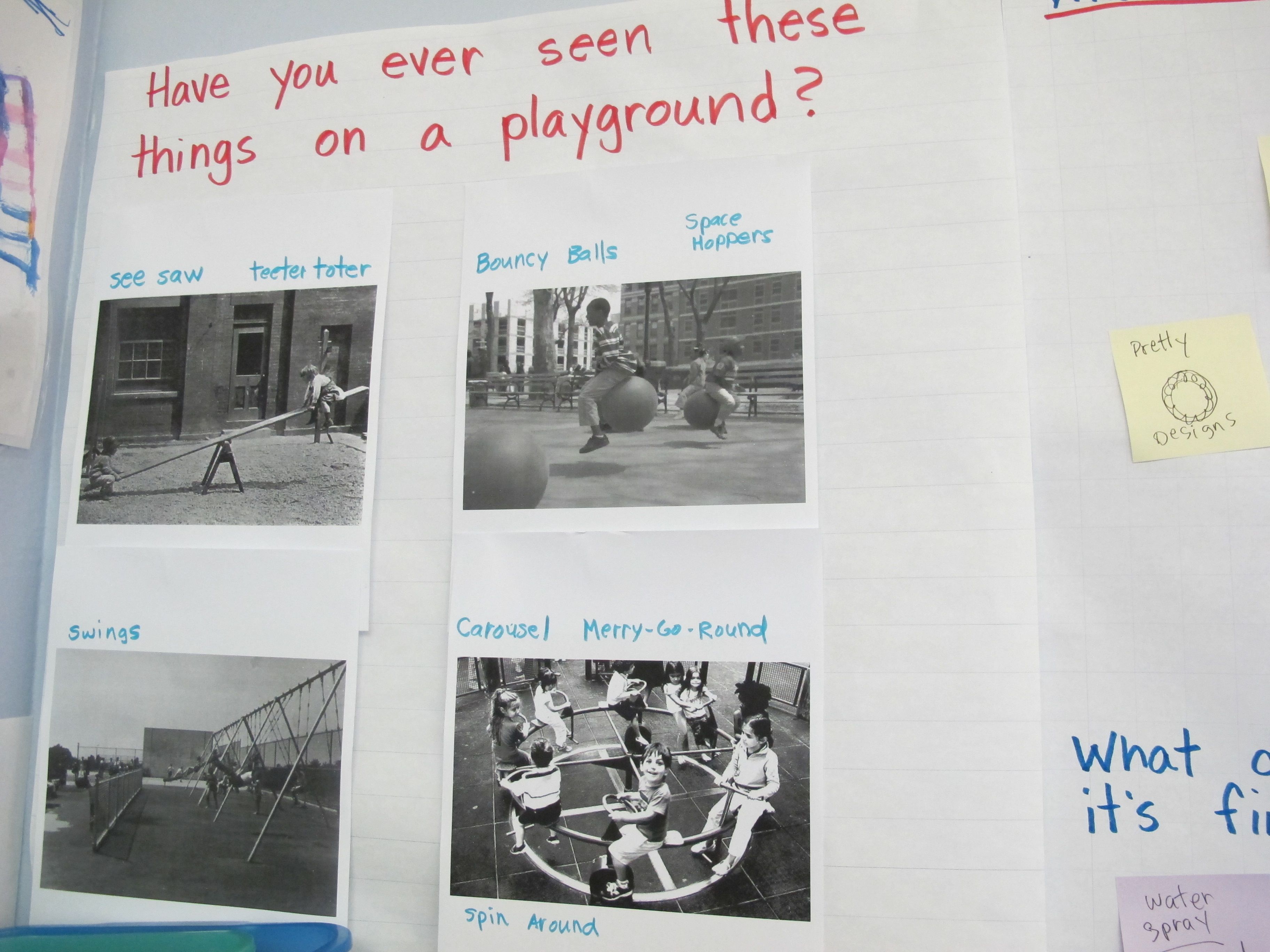
Over the course of the last few months the class has taken many trips to playgrounds both in the neighborhood, in Prospect Park, and around the city. They periodically walk to a nearby site to observe the development of a new playground being built. A few weeks ago they interviewed the playground designer. A notebook is passed from family to family. Parents write and draw sketches of their personal memories of going to playgrounds when they were children. These stories are shared in class.
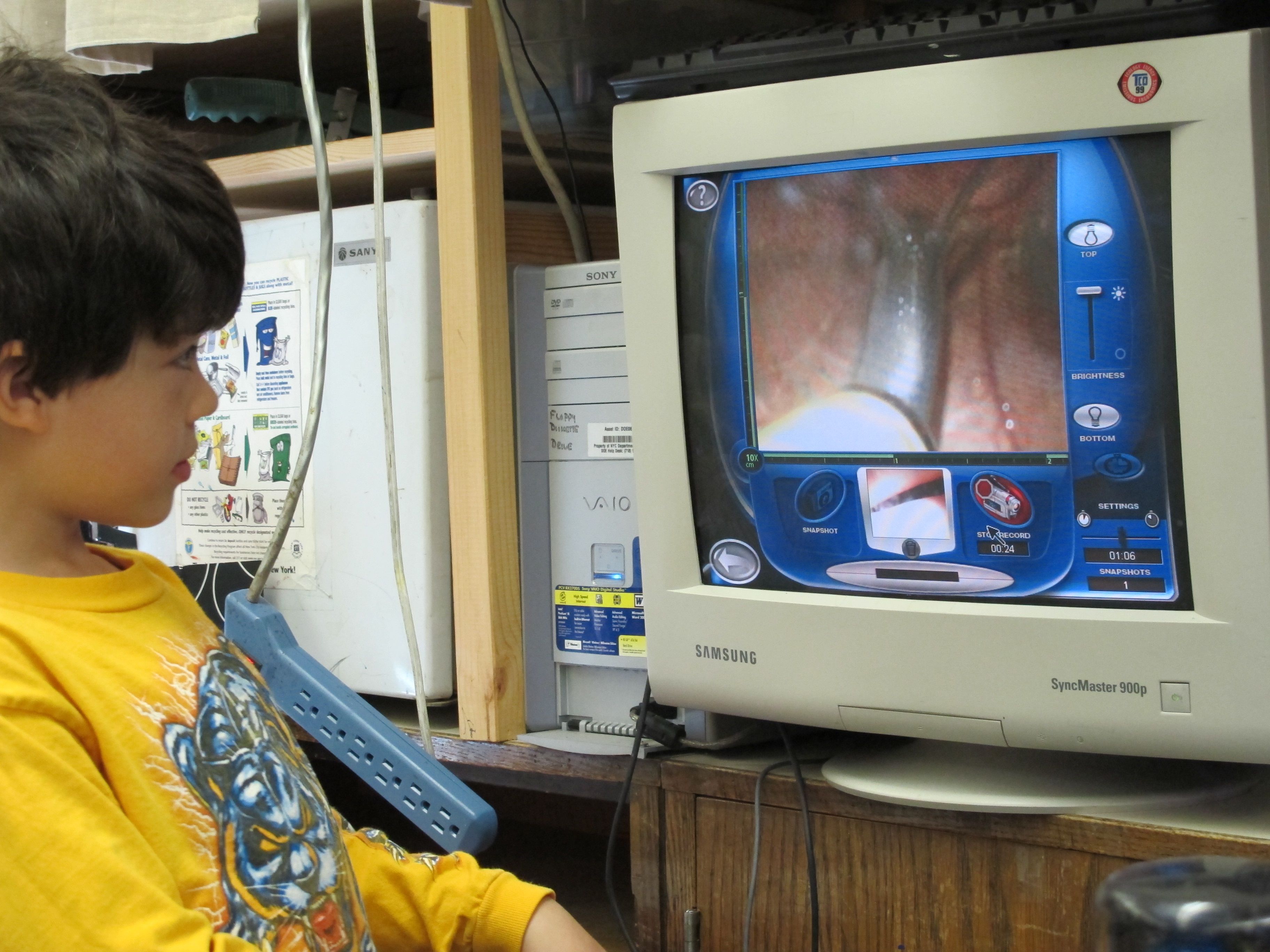
This winter, Bill brought in some snails for the science center. The children conducted all sorts of “snail experiments”. They discovered what snails like to eat, how quickly they move, and, of course, how to care for them. At the art center, we noticed children twisting paper to make snails. They used the digital microscope in the science center to create snail movies.
And then it happened.
Someone came up with the idea of making a playground for the snails. The idea delighted the class and Mr. Bill flew with it. He suggested that they begin collecting boxes and other materials so that they could start the project.
They began by painting the boxes that would become the foundations for their playgrounds.

Children worked in partnerships to draw plans for a snail playground and they shared these drawings with each other.

Then, during Choice Time, children signed up to begin constructing the playgrounds with their partners. When the playgrounds were completed, they signed up for taking turns to bring the playgrounds to the science center so that they could let the snails try out the equipment!
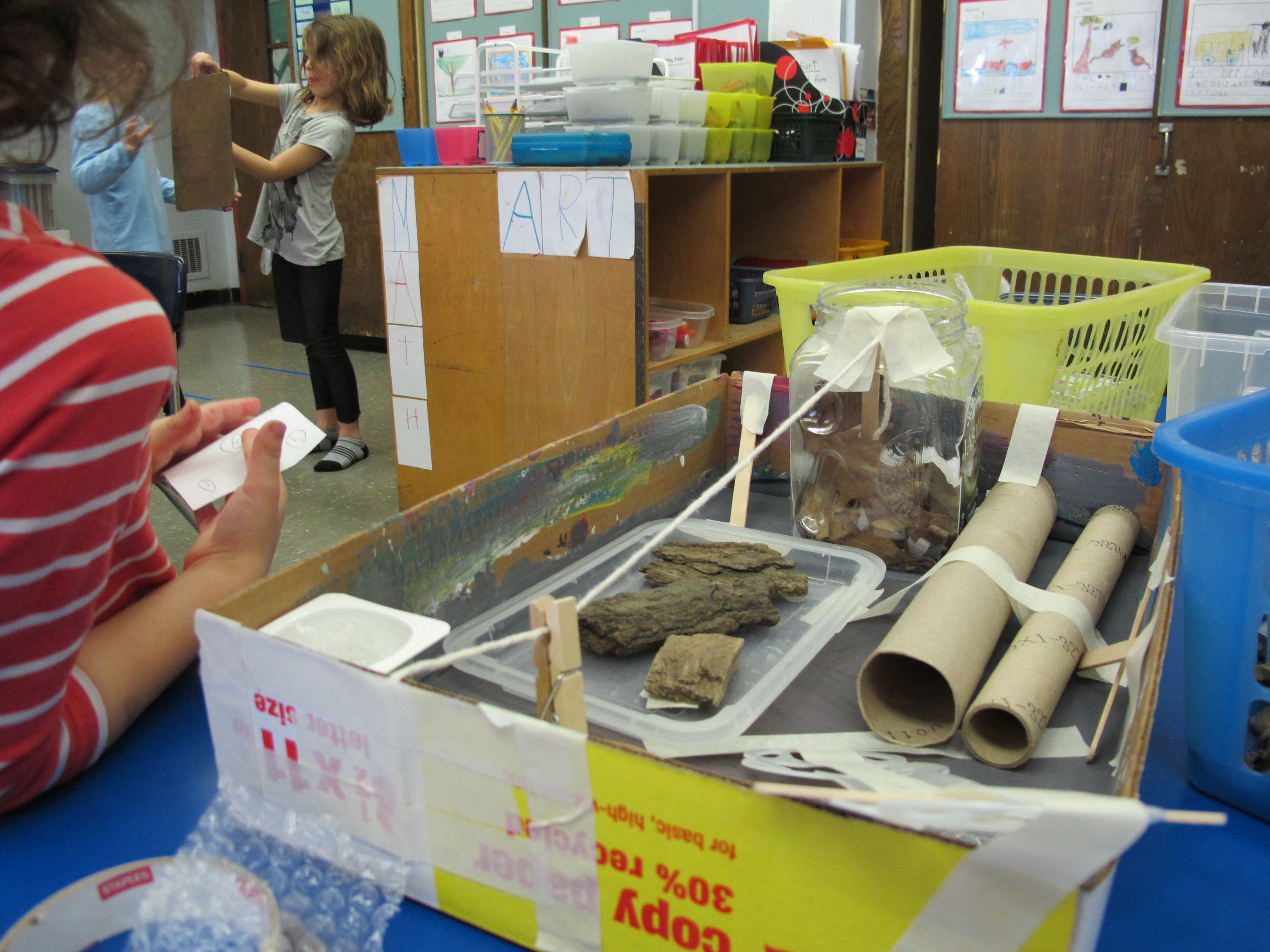

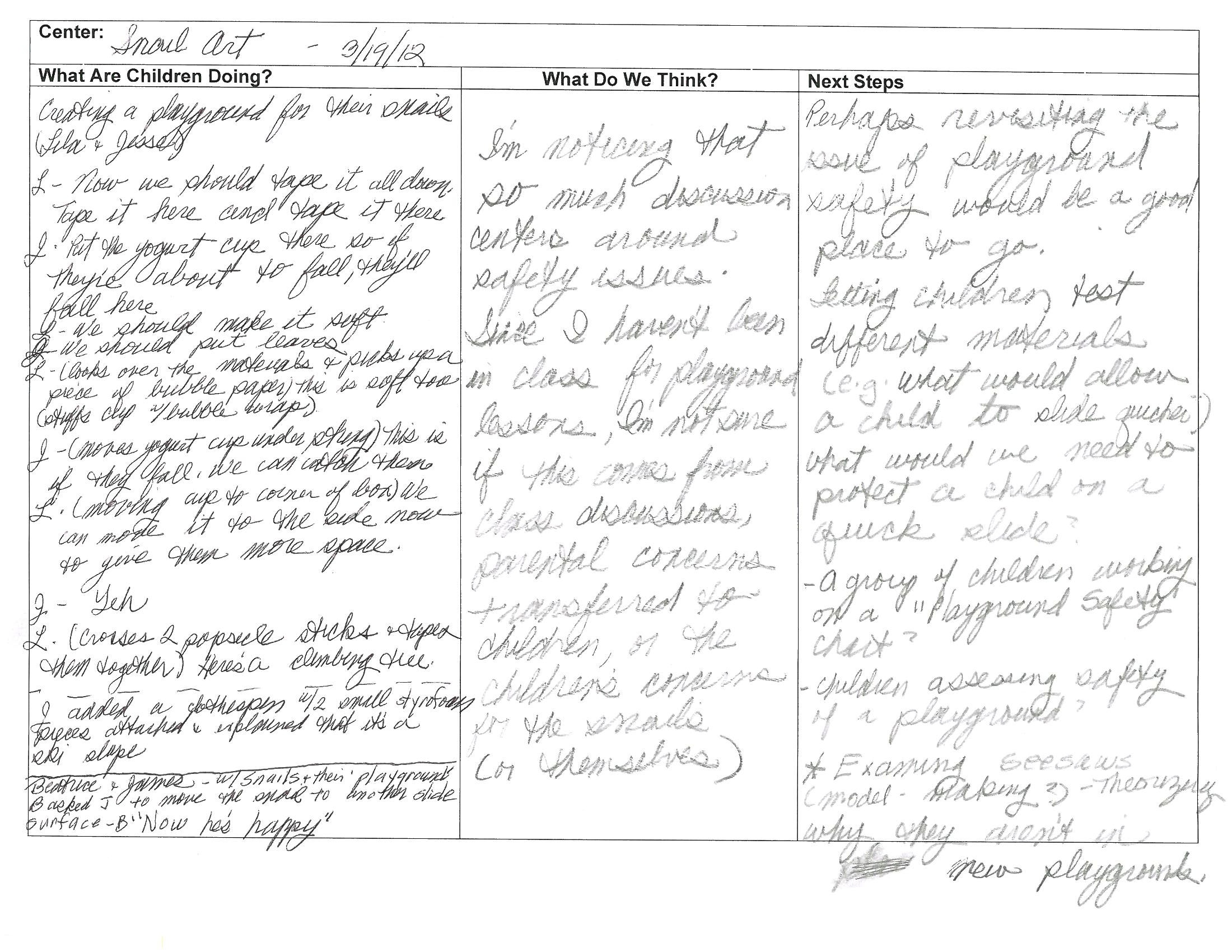
This project is still in progress. Yesterday when I visited the class, I recorded some of my observations as I watched two children at the art center and two at the science center. Later, when I left the class, I looked over my observations and jotted down some thoughts about them and some possible next steps. I noticed that all four of the children seemed particularly focused on issues of safety. Snail safety? Playground safety? I’m not quite sure from my one observation. I’ll share my notes with Bill and get his ‘take’ on this.
It’s so gratifying to see children traveling through this study at a snail’s pace…exploring, creating, collaborating, improvising and having a wonderful time.