Transporting a Classroom Towards Inquiry

I could almost hear a chorus of silent groans coming from the teachers sitting around the table in the staff room at P.S. 10 in Brooklyn. It was March 17th, 2005, my first day working as a consultant at the school. The new principal, Jett Ritorto, wanted me to introduce inquiry projects and investigative Choice Time to the kindergarten teachers. But it was mid-March and this was just one more new addition to their already over-programmed day. I wasn’t welcomed with open arms!

“We can’t do an inquiry project. This is when we start our transportation unit.”
I recognized this plea from my own not-so-long-ago days in the classroom. I had my theme, my materials, and my time-schedule all set up and then, in would walk a new staff developer with her own agenda, turning all of my plans upside down.

I assured them that we would not be dropping the transportation unit. Instead we would see what happened if we approached it in a new way. I suggested that they each go on a neighborhood walk with their class that week, with a focus on exploring the different ways that people could travel, to, from, and around their neighborhood. After the walk, they should encourage children to share their observations. This would give the teachers a sense of what the students already know and also what form of transportation seemed to interest them the most. That would allow them to narrow the focus of the class’s transportation study.

When I came back to the school the next week, I met with each teacher individually. The inclusion team, Dana Roth and Karen Byrnes, were excited and eager to share their experience with me. Their children had lots of questions about the subway and that was where they wanted to focus their study. The three of us spent the rest of the period preparing an anticipatory web, plotting out the many possibilities for a subway study. All seemed well.

Later in the week they contacted me and sadly told me that a subway study was out of the question. One of the students was confined to a wheelchair and would have to be excluded from all subway trips. They decided to switch to a bus study. I suggested, however, that they first bring the problem to the class and see what kind of solution the children came up with.

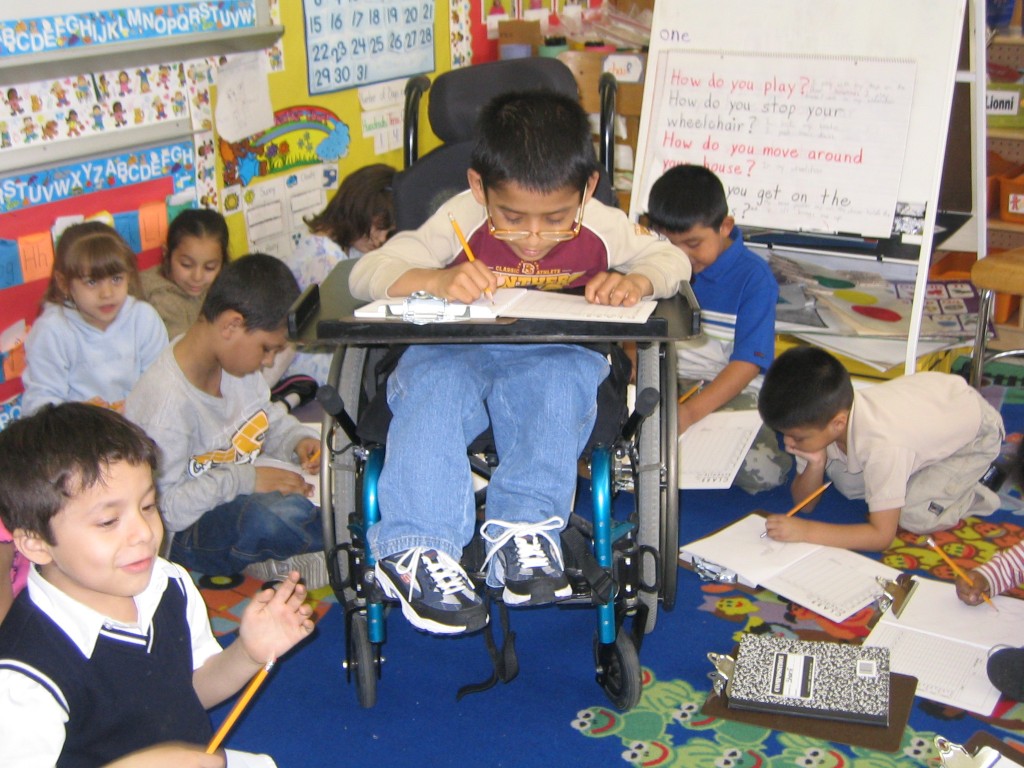
The children were outraged! “That’s not fair! Saim should be able to go on the subway just like us!” Here began a most unusual transportation study – The Wheelchair Project.

The class decided to find out more about Saim’s wheelchair and what it was like for him to move around the school and neighborhood. Saim was pleased as punch to be the center of attention (Dana said that she would not have pursued this route if the child was sensitive about being singled out).

They began the study by interviewing Saim. After the interview, they all sat around him in a circle, observing and drawing. The teachers began webbing what children already knew about wheelchairs and also collecting their “wonderings” on post-its and adding these to the web. From these activities, they decided to focus their study on movement and accessibility. These were the two areas where the children had the most interest.

News about this unusual transportation study traveled around the school like hotcakes. When the school’s physical therapist heard about the investigation, she provided the class with an unused wheelchair. This became a very popular wheelchair observation center. Children used magnifying glasses, tape measures, and detail finders (a square of black paper with a peek-hole cut in the center) to look closely at the different parts of wheelchair. They drew the wheels, the brakes, and the gears. Then they shared their drawings and ‘recordings’ with the children in the block center who were constructing their own version of a wheelchair. This chair took many days to construct. It sometimes fell over and was rebuilt often and eventually was held together with yards of masking tape!


The class visited the school bus that brought Saim to school to see how the lift helped children with walkers and wheelchairs get on and off. They interviewed the driver and also met Manny, a very affable upper-grade child who used a walker to help him move about. Manny was invited to the classroom where he was interviewed. He then gave each child an opportunity to try out his walker.

After this experience, a lift-bus was built in the block center. After a few days, it was deconstructed and the children built “a better lift bus.”

They walked took neighborhood walks, checking to see which stores and sidewalks were “wheelchair friendly.” Then they walked around the school to find out if their school was wheelchair accessible. The front of the school had lots of steps! How did Saim get into school? In an exciting moment of discovery, they found the symbol that they saw on the lift bus, along with an arrow. The class followed the arrows until they came to the ramp entrance. Problem solved!

They visited a neighborhood house that had been altered to make it wheelchair accessible and they interviewed the owner of the building.

This study certainly held the interest of the class and raised a new awareness of the challenges in Saim’s daily life. The children developed a feeling of respect for Saim and for the other children in the school who used wheelchairs, walkers and crutches.

Over the years, I have returned to the school to visit Dana Roth and I’ve always been intrigued by the variety of studies taking place in her classroom. On one visit, the children were investigating colors – inventing colors, exploring the various names of Crayola crayons and coming up with their own inventive names for their newly mixed colors. On another visit, the children were building a school in their dramatic play center, reflecting their investigation of their own school. Dana still does some thematic studies but she also listens closely to her children and develops inquiry projects based on their interests and wonderings.

I haven’t worked at the school for the past five years, but I’m going back in the fall to, as Laura Scott, the new principal, says, “Give a refresher course” in inquiry studies to keep it alive and well at the school. Let’s see what happens.

Are We Killing Kindergarten?


I just read this article by Amanda Moreno, the Associate Director of the Marsico Institute for Early Learning and Literacy. She speaks so well to many of my concerns, so I thought that I would share it with you. That isn’t to say that I am inagreement with every point. I do think that children learn through play although I do agree that play is not a strategy for stuffing knowledge into a child.

Read the article and share thoughts.

Killing Kindergarten
by Amanda Moreno, Ph.D

I want you to know it took a lot of self-discipline not to title this post “Killing Kindergarteners.” In addition to being an early education researcher, I am also a mother of a 5-year-old currently in kindergarten, so I can tell you that is pretty much the way it feels. All around this country, families are trying to figure out why their small children already dread going to a place that was supposed to serve as a gentle transition to formal learning. They are struggling with ambivalent allegiances, not wanting to be the over-protective parent who babies their child, but at the same time not being fully convinced that their child has a behavior problem just because they don’t enjoy sitting at a desk, independently going through worksheets for a solid hour.

It has become axiomatic in my field to say that early learning expectations are a full year ahead of what they were 20 years ago. Alfie Kohn points out an even more critical piece of this puzzle when he says that “The typical American kindergarten now resembles a really bad first-grade classroom” (italics mine). Somehow I don’t think Robert Fulghum’s list of essential lessons learned in kindergarten would have the same ring to it if among “share everything” and “play fair” appeared “100 sight words,” “command of capitalization and punctuation,” and “compose and decompose numbers 11-19.” Cynicism aside, a year’s worth of additional expectations isn’t in itself the biggest problem if you have a highly skilled teacher who can individualize to suit just about any learning style, and can make just about any learning task age-appropriate and engaging. That is a huge if, I would guess, according to most kindergarteners today.

Is teaching 5-year-olds really that complex an enterprise? It is true that little kids are like sponges in that they absorb discrete pieces of knowledge daily, naturally, and without effort, such as new vocabulary, locations of things in their house, how specific toys work, and what their family dinner and bedtime routines are. But in formal learning settings — at least as they are on average in the U.S. — the game completely changes. For better or worse, the “great divider” in formal learning settings may be whether the learner can decide to tackle new tasks or problems, not because she wants to but simply because she is being asked to. Is it OK for my 5-year-old to learn about Native American history and culture? Sure it is. The parts of the eye and inner ear — why not? But there is no intrinsic motivation when the lesson emphasizes the proper spelling “Tlingit” or “cochlea” and there never will be. No, the kindergarteners who do well with this kind of task are the ones who have already developed the ability to override their intrinsic motivation. This takes more than compliance — it takes executive function, which is in part attention and memory, and in part the ability to inhibit a pre-potent response. You know, like my daughter’s pre-potent response to color with the crayon that most attracts her eye, rather than limiting her choices to the browns, yellows, and oranges that were actually found in traditional Native American garb, as the curriculum required.

This sounds awful — like the only successful kindergartener is one with a broken spirit. It wouldn’t have to be this way if the educational system were structured to accommodate the natural, normal, and highly variable rates of development that occur in early childhood. All typically developing children acquire the basics of executive function eventually. So universal a finding across cultures is this, that it came to be known as the “5-to-7 year shift” — and it is the reason why formal schooling starts around this age worldwide. In this country, the word around makes all the difference. Given the range of ages at which children enter kindergarten (there is about a 25-month spread between the youngest and oldest students), and the three-year age range within which executive function skills begin to become more adult-like, children can be anywhere between preschool and third grade when the complex set of abilities required to decide to learn comes online sufficiently well. Even after controlling for age, kindergarteners still show greater variability in executive function than either fifth graders or preschoolers, indicating there is something unique about the cognitive reorganizations that take place during this period of life.

Our educational system is not equipped to support the application of this kind of knowledge. John Medina has said, “If you wanted to create an education environment that was directly opposed to what the brain was good at doing, you would probably design something like a classroom.”

In early childhood, when children are just beginning (and did I mention, at highly individualized rates?) to acquire the ability to focus under non-optimal circumstances and learn anyway, this is not only unproductive (as it is for learners of all ages), it is dangerous. For young children for whom intentional learning isn’t even on the radar screen yet, every day they spend sitting at a desk and filling out worksheets is like being in a foreign language immersion program with a teacher who believes they’re fluent.

This is not a debate about exploratory vs. direct instruction in the early grades, or play vs. structure, or creative learning vs. traditional academics, or any other label for this false dichotomy. Research supports both, depending on the group of children studied and methods used. While I staunchly believe that play is a human right, you don’t fix the misguided question of how to stuff knowledge into a 5-year-old’s brain simply by doing it “through play.” Similarly, when people tell you direct instruction “works,” ask them what it worked for. If the answer was standardized tests, then you merely have an unsurprising match between method and outcome. Either way, bad teaching will be the result if a kindergarten teacher practices (or is forced to practice) any style in the extreme, and without an arsenal of creative tools for individualizing to children. For those brilliant kindergarten teachers who do possess such a toolbox, the standards and testing craze has tamped their best instincts into hiding.

I agree with Holly Robinson who says that, from a parent’s perspective, the immediate answer lies in finding the right fit for your child — a process we are right in the middle of with our own daughter. Unfortunately, good options are not nearly plentiful enough, and those that exist are not accessible enough to families and children that likely need them the most. In the meantime, my colleagues and I are trying to do our part by speaking out for differentiating education reform efforts for young children, incorporating modern child and brain development principles into teacher and principal prep programs, and consulting to early education initiatives about how to answer to the pressures of accountability without “killing kindergarteners” in the process.

Measuring in the Block Center

Nothing ever becomes real ’til it is experienced.

― John Keats

I recently had the pleasant experience of observing inquiry centers in Marta Quinones and Maureen Duffy’s inclusion first grade class at P.S. 142 in Manhattan.
This spring, they decided to begin an inquiry project focused on “My Fit and Healthy Body.” This investigation came out of Maureen’s particular interest in physical fitness and sports. The children were picking up on her enthusiasm for running and exercising. The teachers also hoped that this study might address some of the children’s poor eating habits.

The three of us began by  brainstorming ideas for where this study might go.We created an anticipatory web, listing possible activities, trips, experts, reading and writing projects and math experiences.

The next step was to launch the study and to discover what the children already knew on the topic. Marta and Maureen began collecting the children’s  initial questions or, as they called it, “wonderings”.

The questions flowed from the class! When they organized the post- its  (small sticky-notes that the teachers used to record the students’ questions), the children and the teachers noticed was that there were many questions about bones. How do they break? Can they bend? How do they get fixed? How many do we have? How do we take care of them? Can they bend backwards? Do animals have the same bones as us? The questions were filling up the page of wonderings.

The direction of the study was now clear – finding out more about our bones!

On the morning of one of my school visits, I met with the two teachers for a planning meeting. I wanted to know what had happened since I was last there and what the teachers thought should be the “next steps” in the study. Marta noticed that a  group of children were attempting to construct a model of a human skeleton in the block center. Their project, however, was becoming unfocused and chaotic. We discussed some possible strategies for supporting  this project. We thought that they might take some time to look at and discuss  anatomical illustrations with the children. Perhaps, after looking at the drawings, they might want to create a ‘blueprint’ on mural paper for their block skelton. Marta thought that she would give this suggestion a try. Maureen planned on looking at xrays with a group of children.

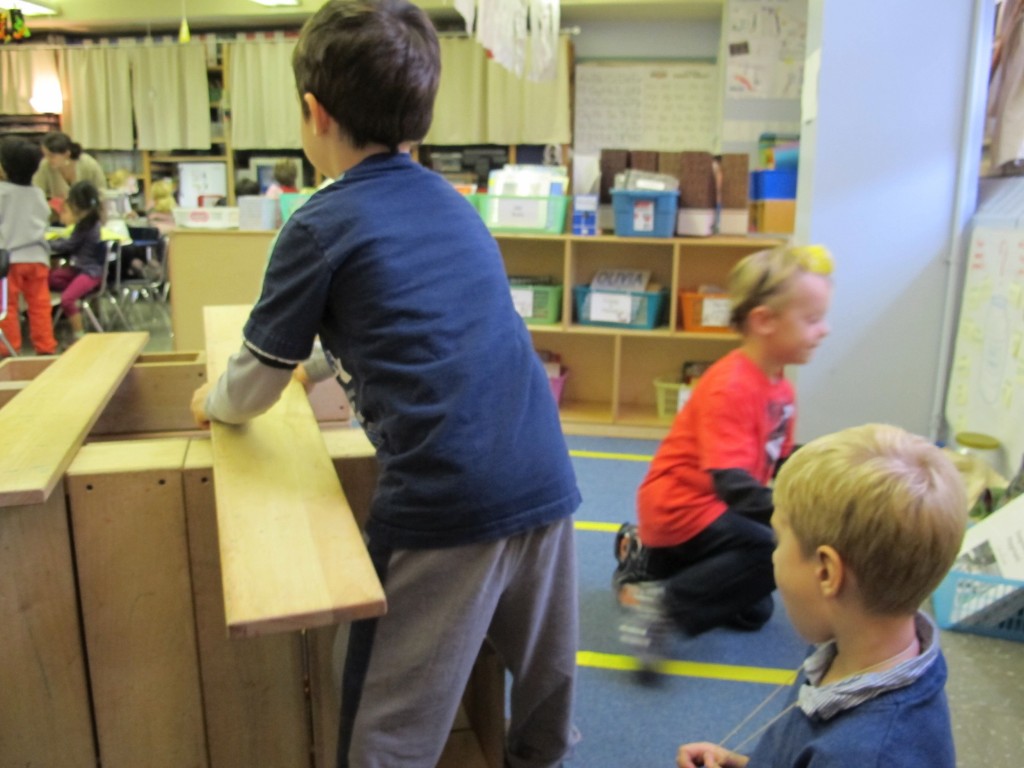
Later in the day, I visited the classroom during Inquiry Center time. The children in the block center were working on their blueprint. They were using a foam rubber life-sized skeleton puzzle as a model for their construction. They also used a ruler to assist them in measuring unit blocks. The wanted to determine which block would match the size of the puzzle piece. They wanted it to be just the right size for their block skeleton.

As I sat on the side, observing, I was struck by the children’s collaboration and also by Marta’s calm, non-intrusive support of their work.

To my delight, I witnessed an unexpected example of children making an important discovery – Piaget’s theory about the conservation of matter! We often assume that children understand numerical consistency. Young children, however, don’t always understand that  five blocks arranged side by side will be just the same size as five blocks stacked vertically. In this little video clip from Marta and Maureen’s classroom, though, we can see how important a discovery it is that 11 inches stays the same, horizontally AND vertically!


An Important Letter to the NYS Commissionner of Education

My former colleague, Liz Phillips, the principal of P.S. 321, Park Slope, Brooklyn, wrote this important letter to the commissionner of education in New York State. It’s a must read. Your thoughts will be shared with her if you like.

October Study Tour to Reggio Emilia for Literacy Educators !

October 2012 Study Group for Literacy Educators
Loris Malaguzzi International Center
REGGIO EMILIA, ITALY
October 23- 26, 2012

Matt Glover and I have been working over the past two years to secure a study tour to the schools in Reggio Emilia, Italy.

THERE ARE STILL PLACES OPEN IN OUR GROUP. HOWEVER WE NEED TO SEND IN THE FINAL NUMBERS BEFORE THE END OF APRIL.

Matt and I share an interest in philosophies inspired by the educators in Reggio Emilia as well as effective practices in early literacy. We often feel like we have one foot in the world of effective literacy learning and one foot in the world of Reggio inspired practices. As we wrote in our study tour proposal:

“With one foot in each world, we have seen connections and bridges between these worlds that many educators miss. We read books by Katie Wood Ray and Ellin Keene and write “Reggio” in the columns constantly, even though Reggio Emilia is never explicitly mentioned. We visit schools like the Center For Inquiry in Columbia, South Carolina and The Brooklyn New School and see connections to the schools we’ve visited in Reggio Emilia, even though many of those teachers have never been to Reggio. We listen to literacy educators like Peter Johnston talk about interactions between children
and adults that are reflective of experiences at La Villetta watching Giovanni Piazza talk with children.

The goal of this proposed study tour is to create a bridge between these two worlds. We want to take some of the most passionate thinkers about children and literacy in the United States to Reggio Emilia so that they can see the connections between Reggio and their own work. Our hope is that the impact this study tour has on participants, and their subsequent writing, will be a force for positive change in education of the United States. ” Both of our visits to Reggio Emilia resonate in our work today.

PLEASE CONTACT ME ASAP IF YOU ARE INTERESTED IN JOINING THE GROUP AND/OR IF YOU NEED MORE INFORMATION.

HERE IS A LIST OF THE PARTICIPANTS, AS OF TODAY, APRIL 17th:
Kathy Collins
Heidi Mills
Peter Johnston
Vicki Vinton
Leah Mermelstein
Andrea Lowenkopf
Michelle Boden White
Anna Allanbrook
Mary Baldwin
Teresa Belisle
Mi Benson
Renée Dinnerstein
Amy Donnelly
Matt Glover
Ben Hart
Madeline Heide
SallyAnn Jeffreys
Stephanie Jones
Maya Nelson
Patti Pinciotti
Heather Radar
Rachel Schwartzman
Ena Shelley
Mary Lisa Vertuca
Steve Wilson
Teresa Young
Susan Adamson
Debbie Corpus
Anna Jaross
Susan Mitchell
Cynthia Merrill

Study Group Program Highlights
Workshops and discussions groups
 with a focus on extending many of the basic understandings and practices to grades beyond the preschool grades.
• Sharing experiences among participants
• Presentations by pedagogistas, atelieristas and teachers on the identity, aims and principles of the educational project
• Presentation and analysis of research projects realized inside the Preschools
• Visits to the Preschools
• Time at the Loris Malaguzzi International Center to see the current exhibitions and ateliers, and to visit the Documentation and Educational Research Center
• Visits within the city of Reggio Emilia encountering the town community

Daily Schedule

The days are full. Typically we will begin at 8:30 or 9:00 a.m. and end between 5:30 and
7:30 p.m. with a lunch break midday. Some evening options will be scheduled as well. The
organization of the days gives visibility to the values of the philosophy through a combination of center visits, plenary sessions, presentations, discussion groups and exchange of experiences between the participants and the pedagogistas, teachers and parents of the Reggio experience.

International Meeting Place

The venue for the study group is the Loris Malaguzzi International Center Loris Malaguzzi, which opened in February 2006 and has recently been completed. As described by Carlina Rinaldi, Pedagogista and President of Reggio Children, “It was created to give greater value to a strong and distinctive characteristic of Reggio Emilia; the ability to lend listening, visibility and support to the rights and requests of children, young people, families and teachers. The Center is a dedicated meeting place where professional development and research intersect for people in Reggio Emilia, Italy and the world who wish to innovate education and culture.”

Prior Preparation

Participants should be familiar with the history and fundamental principles of the Reggio Emilia approach to education so that they have some contextual framework before being immersed in the actual experience. Recommended readings are posted on the Articles page in the Print & Video Resources section of the North American Reggio Emilia Alliance (NAREA) website: www.reggioalliance.org. A general bibliography is posted in this section as well. Prior study group participants as well as first time visitors are welcome to attend.

Cost per person; $1,520
The Study Group cost includes the participation fee to Reggio Children and services provided by Angela Ferrario and International Study Tours, LLC. It does not include airfare or hotel accommodations.(hotel list attached with special rates for participants)

Participants are responsible for their own meals and for booking their flights and hotel.

Participation Fee to Reggio Children S.r.l. includes:
– The organization and presentation of the study group program for the week
– An informational folder for each participant with materials about the town of Reggio Emilia, its municipal infant-toddler center and preschools, Reggio Children, and the Loris Malaguzzi International Center
– Private bus transportation to and from the centers in Reggio Emilia when required by the program
– Professional interpreters when required by the program
– Insurance as specified in Responsibility clause below
– Refreshments during coffee breaks each day
Services provided by Angela Ferrario and International Study Tours, LLC include:
– Coordination of registration process and study group experience to support professional development, collaboration and collegiality among participants
– Facilitation of communication between study group organizers and colleagues at International Office of Reggio Children
– Compilation of participants’ brief professional narratives into a document that is distributed to the group and to Reggio Children
– Availability to participants by phone and email prior to departure
– Credit card services and foreign currency transfers

Hotel Information


Hotel Posta <info@hotelposta.re.it> (annex)

Single room Eur 58.00($77.33)

Double/Twin room Eur 87.00($115.99)

The rates are per room per night and inclusive of taxes and breakfast served at Hotel Posta (we are the Annex of this Hotel)

————————————————————————————————–

Hotel Posta

Piazza del Monte, 2

tel  +39 0522 – 432944

fax +39 0522 – 452602

www.hotelposta.re.it

www.albergoreggio.it

www.cavazzone.it


Single room Eur79.00($105.32)

–          Double for shared occupancy Eur. 99.00(131.99)

–          Rates are meant er room per night and include taxes and buffet continental breakfast

tel  +39 0522 – 432944

fax +39 0522 – 452602

www.hotelposta.re.it

———————————————————————————

Albergo Delle Notarie <notarie@albergonotarie.it>

twin room (2 beds) (single) ($93.32)and 105.00 (twin) ($139.99)breakfast included.

————————————————————————————–

Albergo Morandi <info@albergomorandi.com>

– single room            64.00 €($83.32)

– double room          95.00 €($126.65)

Buffet breakfast, a free service of cafteria during the day, wi-fi and garage are included.

—————————————————————————————————-

Hotel San Marco

1 Single Room wiht breakfast included                                                      per room per night($66.66)

1 Double Room (2 Beds) with breakfast included                                                         per night ($99.99)

—————————————————————————————– 

HOTEL EUROPA <info@hoteleuropa.re.it>

–          One single room 87,00 euro($115.99) per night

–          Twin room 107,00 euro ($142.65)per night

–          International breakfast

–          Internet Connection WIFI

–          Parking / Garage

Tel. +39 0522-432323

Fax. +39 0522-432442

info@hoteleuropa.re.it

www.hoteleuropa.re.it

———————————————————————————————


ASTORIA REGGIO EMILI

1 Single Standard room 1 person BB (Bed & Breakfast)

($106.66) per room per night


1 Twin bedded room 2 persons BB (Bed & Breakfast)

($113.32)per room per night

Rate are including breakfast, outside parking, Fitness room, newspaper and Internet Acces from the room.


We offer three choice of breakfast:


Breakfast “GRAND REGAL” :         a buffet breakfast with the kind of choice that’s bound

to please.

Italian Breakfast ” Coffee&Croissants“:   quick and friendly, coffee and pastry at the bar.


With supplement:
Breakast “Dolce risveglio”  :            15,00 per person, the comfort of a breakfast in bed. Wake up in your time with

CHOICE TIME MEMORIES

“…stand aside for awhile and leave room for learning,
observe carefully what children do, and then, if you
have understood well, perhaps teaching will be
different from before.”
Louis Malaguzzi (Edwards, Gandini, Forman, 1995)

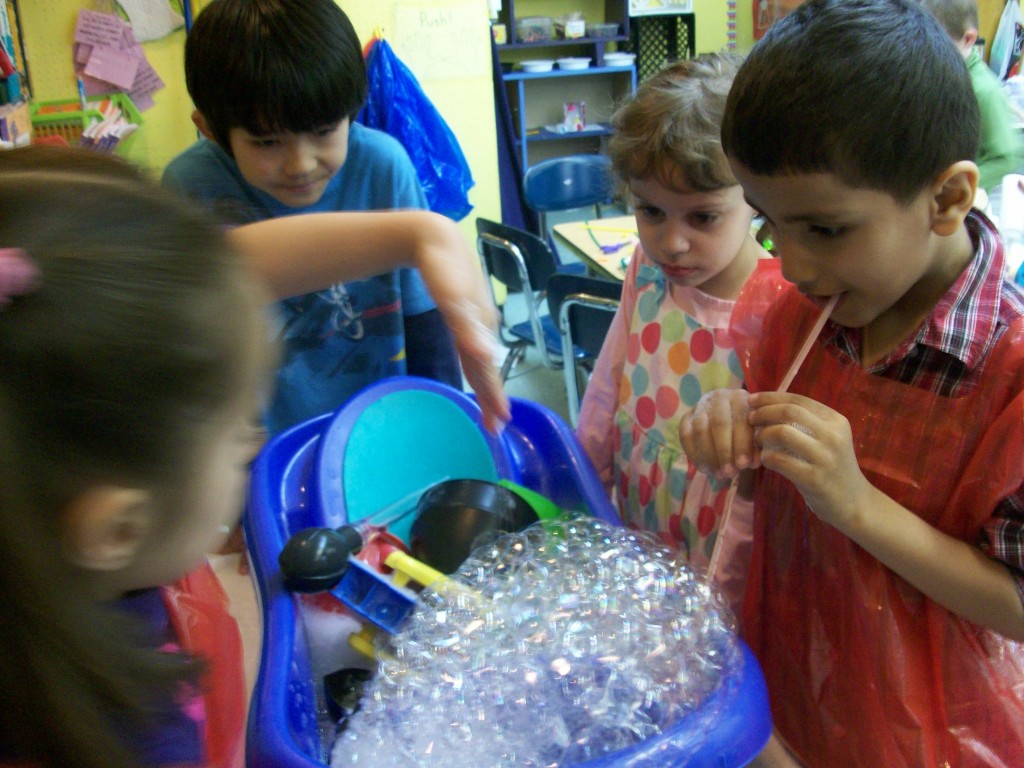
Some years ago, my daughter visited my kindergarten classroom during Choice Time. As she looked around the room, she observed the children at their various activities. One group was setting up a pretend doctor’s office in the dramatic play corner. At the art center, children were constructing spaceships from toilet paper rolls and egg cartons. Four children, wearing plastic goggles, were using screwdrivers and pliers to take apart a broken telephone; two children were busy at the water table constructing a water machine with plastic tubing and funnels. Simone seemed fascinated by the life of the classroom.

“Whenever I come into your class at Choice Time, I feel like I’m walking into The King of Hearts she said, referring to a wonderfully magical film, a family favorite. The story takes place in a small French village during the First World War. After hearing news of an oncoming invasion, the villagers quickly fled to the countryside, accidentally leaving the gates of the town asylum unlocked. The innocent residents walk around the empty town in a state of wonder and amazement. They take over the jobs of the absent villagers, understanding some aspects of each role, but adding their own, highly serious, sometimes comical, interpretations as they attempted to recreate life in the outside world.

Kindergarten children are also filled with a sense of wonder and amazement. When they have the opportunity to self-direct their activities at Choice Time, they are attempting to make sense of the adult world. If we listen closely to their conversations and monologues, we can become privy to many of their understandings, misunderstandings, and questions.

Four children have transformed the Pretend Center into a doctor’s office. The wooden play stove, now covered with white paper, is the examining table. Placing her baby doll on the table, Elena, a bubbly five-year old dressed up in silver high-heels and my daughter’s outgrown fancy party dress, wails, “My baby is dead.” Jeffrey, now the ‘doctor,’ dressed in an oversized white shirt with a stethoscope dangling from his neck, takes rapid notes on a pad. “Don’t worry, I’ll fix the baby.” Jeffrey, taking a needle from the play doctor’s kit, jabs the baby’s arm. “O.K. now. The baby’s not dead anymore.” Elena picks up her baby, hands over a wad of play money from the pocketbook draped over her shoulder, and happily teeters away, balancing herself on her high-heeled shoes.In the block center, Luca has enclosed Karl inside what looks like a house without doors. Each time Karl’s arm reaches out, a wooden block falls down and Luca quickly replaces it. Then he runs to our reading nook, where we have a collection of stuffed animals. Selecting one, he returns to his construction, passing a stuffed animal to Karl. I observe this happening again a few minutes later. Each time Karl’s arm comes out and a block falls down, Luca replaces it adding another animal to Karl’s growing collection. Curious about this, I ask Luca about his building. “Karl is in jail, but don’t be worried. I bring him toys so he won’t be scared.”

Unfortunately, Luca’s father is in jail. Luca doesn’t ever speak about this. Not with me. Not with his friends. Not with his mother. He keeps his feeling hidden deep inside. Somehow, in his play with Karl, he found a safe outlet for expressing his fears and concerns. He found a way to make the experience of being incarcerated safe for his father and less threatening for himself.

Choice Time is Playtime. Playtime is Work time!

The children think of the hour in the day that I call Choice Time, as their playtime, I know that it is so much more. When I plan centers, I keep in mind these big goals: children should develop independence and self-confidence; centers should be ‘open’ enough to allow for children making interdisciplinary connections and developing personal inquiries; opportunities for using reading, writing and mathematics for natural and authentic purposes should be available in each center; the activities should allow children to work out social conflicts within a safe, protective environment and support their ability for developing positive social skills.

A high-standards kindergarten curriculum, should include opportunities for children to develop reading and writing skills. These are sometimes taught using the structure of reading and writing workshops. There’s time for word study, read – aloud , and mathematical instruction. There should be many opportunities for whole-class and small group discussions on a variety of topics. These can be from teacher or child generated ideas.

When we develop a classroom that encourages inquiry and exploration, we empower children, giving them skills they will use throughout their lives. When we plan Choice Time with this same philosophy and intent, we open up opportunities for helping children to grow socially and intellectually. This can occur when we encourage children to find ways of recording and sharing their discoveries at the sand table, write messages to each other in a class post office, label their art work, put up important signs by their block buildings, write a recipe for making playdough or make new jackets for their favorite storybooks. If children are making Valentine’s Day cards at a center, merely by attaching writing paper to the cards, we extend the activity in a way that says, “here’s where I will write my message.” If we celebrate, display and share the exciting moments and products of Choice Time play/work we’re sending to children, families and administration a loud and clear message about the importance that we place on exploration, inquiry and, yes, play, in the life of a five year old child!

Snails on a Ski Lift! A Playground for the Snails

Shelly Kee, Shelly Kee Bookey
Put out all your horns,
All the ladies are coming to see you*

*Irish children’s chant – you can hear it on iTunes: http://itunes.apple.com/us/album/so-early-in-morning-irish/id162653706

(you can hear the chant if you click on the link and then click on Shelly Kee Bookey!)

All children seem to love playgrounds. They don’t need instruction on what to do with climbing bars, swings, a sandbox or a crawling tunnel. They run right off to play.

It’s not unusual to see children become fascinated with a ladybug crawling across a branch, an ant working its way over a fence or a caterpillar inching itself through the grass.

Children are naturally curious and full of energy.

So what happens in a kindergarten class where children who are studying playgrounds are introduced to a tankful of snails in their science center?

A playground for the snails!

Of course this magical combination of a snail study and playground study needs some special conditions to allow this idea to take shape. It needs children who have had opportunities to visit and play in many playgrounds. These children need to have had the time and encouragement to freely observe and explore snails in their science center. There should have been many experiences for children to use their imagination as they worked with a variety of open-ended art materials. AND, quite importantly, there needs to be a teacher who values exploration, inquiry, play and imagination.

You will find all of these ingredients in Bill Fulbrecht’s kindergarten class at P.S. 321 in Brooklyn, New York.

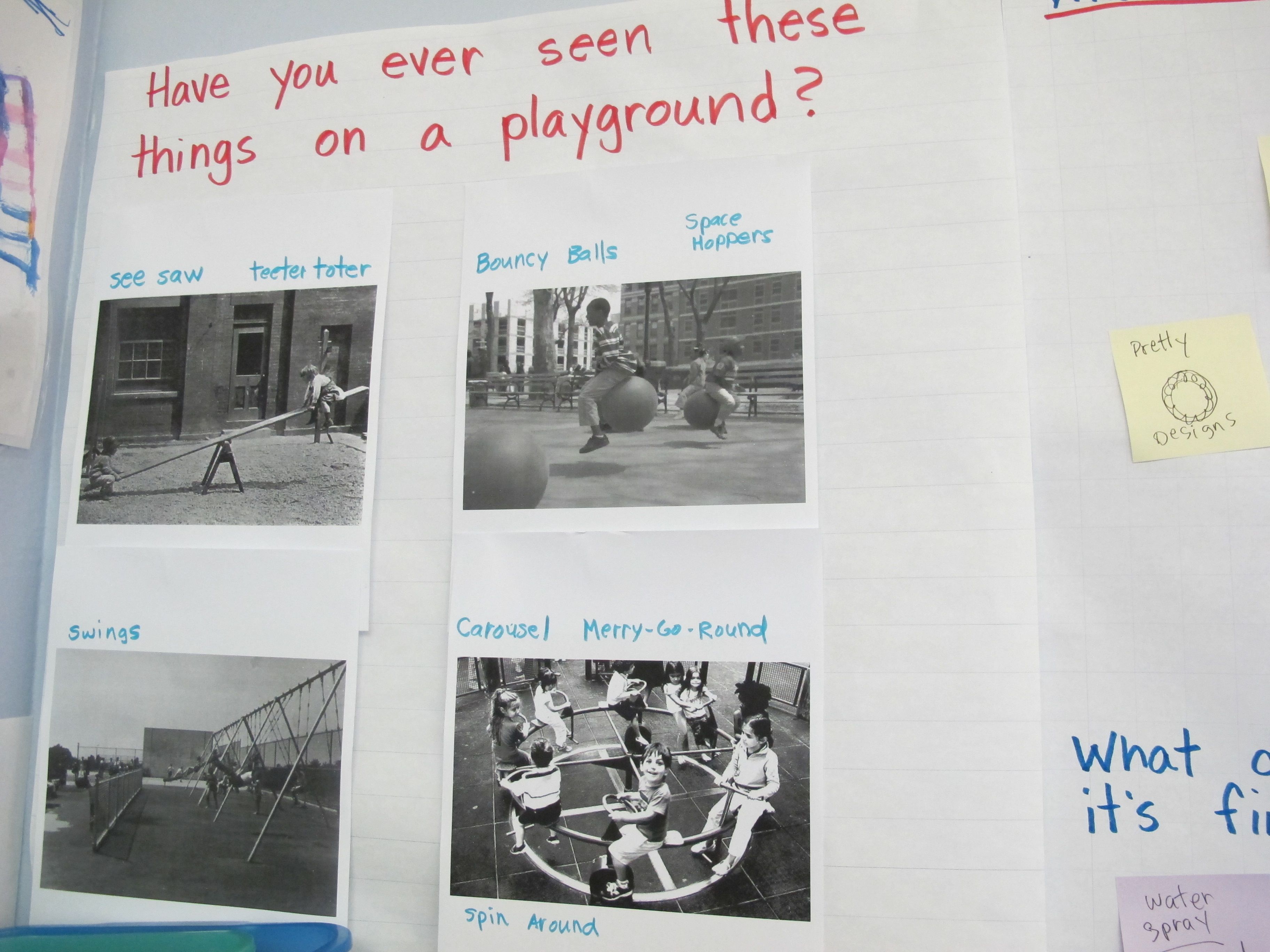
When I visited during Choice Time this week, the children were in the midst of the playground study that began even before the start of the school year. During the summer Bill sent out a letter letting the children know that they were all going to become playground experts that year! He encouraged the children to bring in, on their first day of school, drawings and pictures of playgrounds. The seed for the study was planted!


Over the course of the last few months the class has taken many trips to playgrounds both in the neighborhood, in Prospect Park, and around the city. They periodically walk to a nearby site to observe the development of a new playground being built. A few weeks ago they interviewed the playground designer. A notebook is passed from family to family. Parents write and draw sketches of their personal memories of going to playgrounds when they were children. These stories are shared in class.

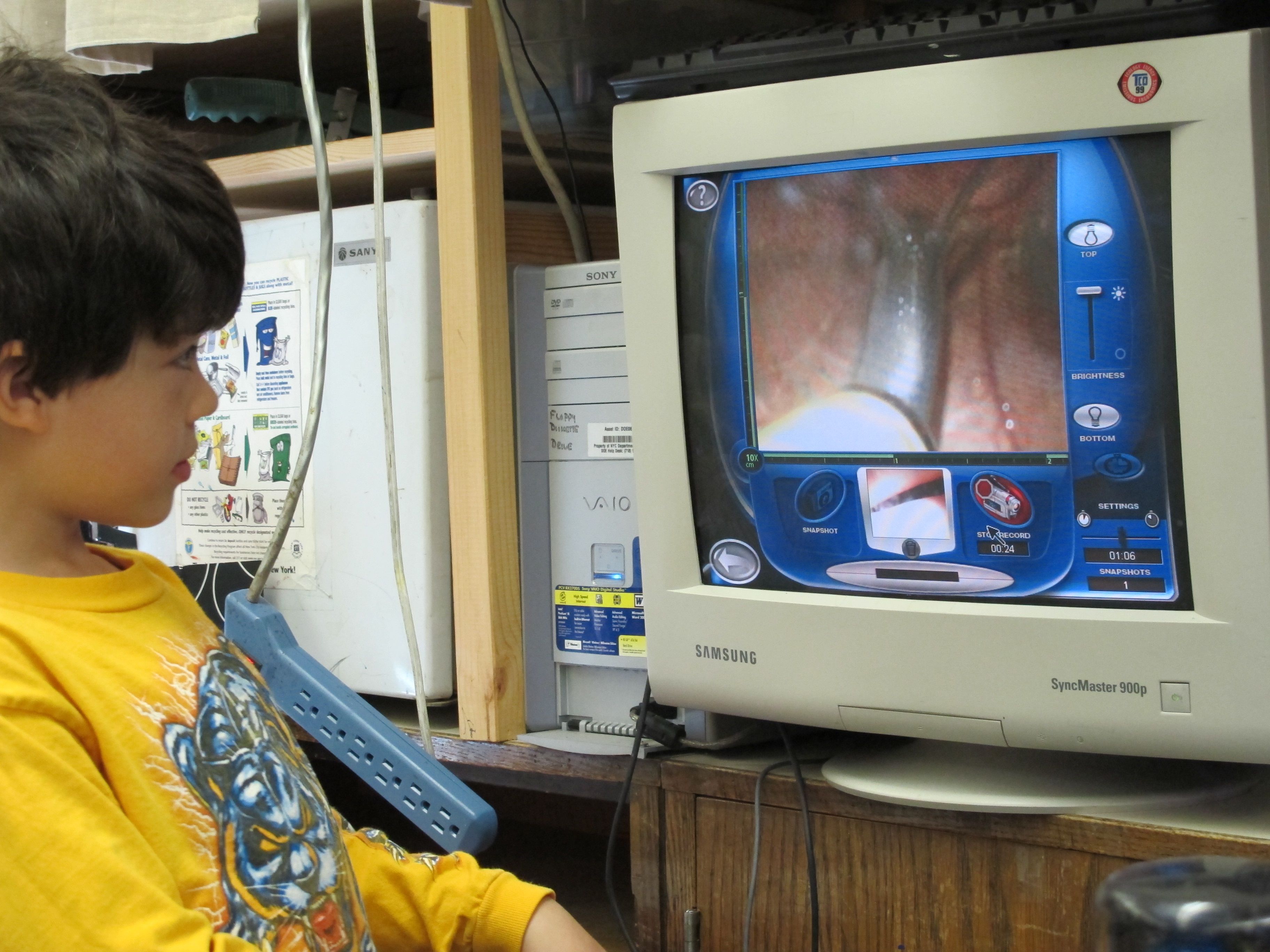
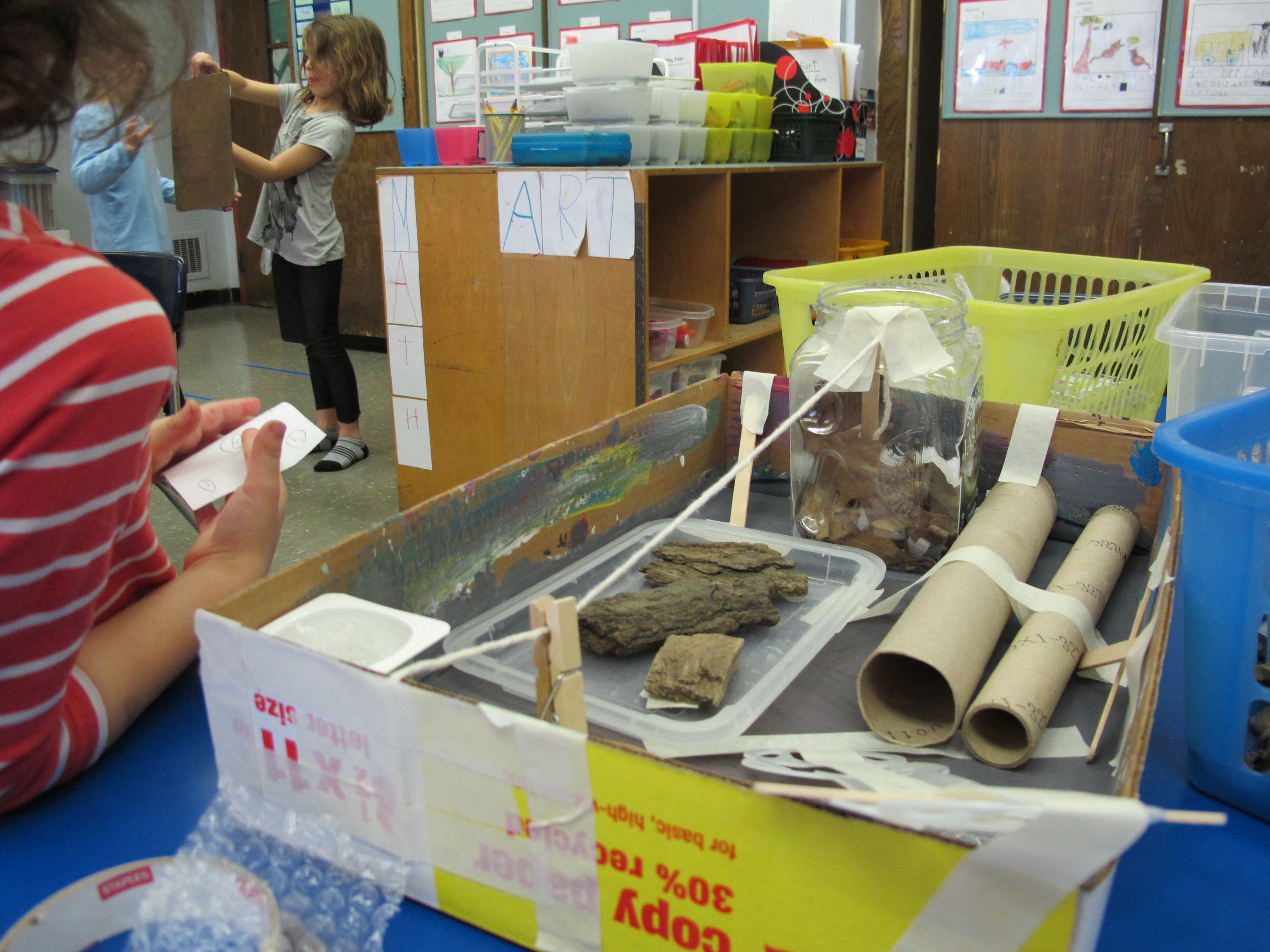
This winter, Bill brought in some snails for the science center. The children conducted all sorts of “snail experiments”. They discovered what snails like to eat, how quickly they move, and, of course, how to care for them. At the art center, we noticed children twisting paper to make snails.  They used the digital microscope in the science center to create snail movies.

And then it happened.

Someone came up with the idea of making a playground for the snails. The idea delighted the class and Mr. Bill flew with it. He suggested that they begin collecting boxes and other materials so that they could start the project.

They began by painting the boxes that would become the foundations for their playgrounds.

Children worked in partnerships to draw plans for a snail playground and they shared these drawings with each other.

Then, during Choice Time, children signed up to begin constructing the playgrounds with their partners. When the playgrounds were completed, they signed up for taking turns to bring the playgrounds to the science center so that they could let the snails try out the equipment!


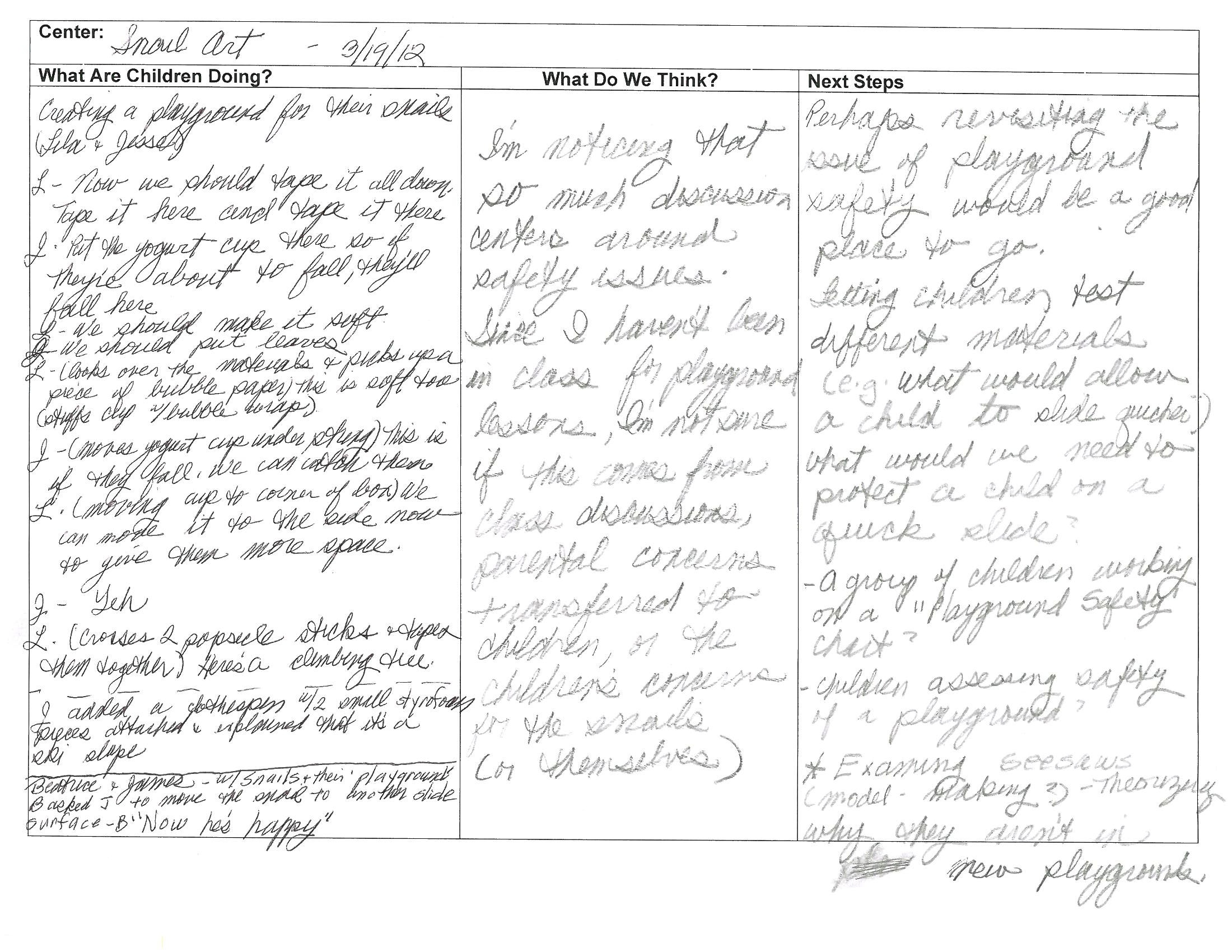
This project is still in progress. Yesterday when I visited the class, I recorded some of my observations as I watched two children at the art center and two at the science center. Later, when I left the class, I looked over my observations and jotted down some thoughts about them and some possible next steps. I noticed that all four of the children seemed particularly focused on issues of safety. Snail safety? Playground safety? I’m not quite sure from my one observation. I’ll share my notes with Bill and get his ‘take’ on this.


It’s so gratifying to see children traveling through this study at a snail’s pace…exploring, creating, collaborating, improvising and having a wonderful time.

In Defense of Childhood: Keeping the Joy of Learning Alive – A Conference for Educators and Parents

If you are in New York City on March 10th, there’s a very exciting conference taking place at City College. There isn’t any charge for attending but you must first register.

About CCNY Areas of Study Admissions Tuition Financial Aid Library Student Life Public Safety Directory

The City College of New York’s Graduate Programs in Early Childhood Education, Psychology Department, Educational Theater Program, Colin Powell Center for Leadership and Service, Auxiliary Enterprise Corporation, Office of Student Services, New Educator journal, and School of Education’s Retired Faculty Association, and Lillian Weber Fund invite you to attend a conference in honor of the School of Education’s 90th anniversary

IN DEFENSE OF CHILDHOOD:
Keeping the Joy of Learning Alive
A Conference for Educators and Parents

Saturday, March 10, 2012, 9am-4:30pm

The Great Hall (in Shepard Hall)
The City College of New York

The widening gap in our society between children of low-income backgrounds their more affluent peers, along with new insights gained from an explosion of research in the neurobiological, behavioral, and social sciences, have captured the public’s attention about the importance of childhood and the need for high quality education. The means to achieving these goals, however, has recently focused on preparing children for school success primarily through an emphasis on standardized testing. This has been done at the expense of what research and educators’ experience tell us: Optimal learning results when the whole child is supported in his or her cultural context; when teaching fosters active engagement, is responsive to diverse cultures and languages, supports family involvement in learning, and develops not only cognitive skills but other human attributes such as curiosity, perseverance, empathy, flexibility, resilience, and social awareness.

It is in the context of these issues that this conference addresses how educators and schools can nurture children in accordance with their developmental needs and teach them in the ways that they learn. Presenters will share effective practices and make recommendations for how school and societal challenges can be negotiated to create more effective and more equitable learning environments to enhance the life chances of our youngest citizens.

9:00-10:15: Plenary in the Great Hall (Shepard Hall) with keynote speaker, Nancy Carlsson-Paige (author of Taking Back Childhood)

10:30-12:00: AM Workshops

12:00-2:00: Lunch and Cultural Arts Fair/Book Fair with featured speaker

1:45-3:00: PM Workshops

3:15-4:30: Closing Plenary: Panel discussion on “The Good Childhood/The Good School: Giving Our Children What They Deserve” followed by a children’s performance

ADMISSION IS FREE

Register

Conference am and pm sessions

Sponsoring organizations: The City College of New York’s Graduate Programs in Early Childhood Education, Psychology Department, Educational Theater Program, Colin Powell Center for Leadership and Service, Auxiliary Enterprise Corporation, Office of Student Services, New Educator journal, School of Education and School of Education’s Retired Faculty Association, and the Lillian Weber Fund.

Supporting organizations: Alliance for Childhood, American Museum of Natural History, Bank Street College of Education, Child Care Council at CUNY, Child Development Institute at Sarah Lawrence College, City College Child Development Center, Community Playthings, Democracy Inquiry Group of New England, Manhattan Country School, New York City Early Childhood Professional Development Institute of CUNY, SciPlay Center of the New York Hall of Science, and the UFT Teacher Center.

In Defense of Childhood: Keeping the Joy of Learning Alive
March 10, 2012
BREAK-OUT SESSIONS
(There will be no advance registration for sessions)

AM Sessions: 10:30am-12:00pm

The Mutt-i-grees Curriculum: Teaching Social and Emotional Skills
Room: North Academic Center (NAC) 2/203
The Mutt-i-grees Curriculum is a comprehensive program that bridges humane education and Social and Emotional Learning (SEL), In a series of easily implemented lessons, the Mutt-I-grees Curriculum enhances children’s social and emotional skills and introduces them to Mutt-i-grees, a new term for shelter pets. Developed by the North Shore Animal League America, in collaboration with Yale University School of the 21st Century and TV’s Dog Whisperer Cesar Millan, the Curriculum has been implemented in hundreds of schools in 40 states. The workshop will include the research base on SEL, resiliency and human-animal interactions review of lessons and best practices, bringing a dog to class and findings of preliminary evaluations which show that curriculum outcomes include improved behavior and social skills among students and increased parent involvement.
Misty Ginicola, Training and Evaluation Associate, Yale School of the 21st Century, the Mutt-i-grees Curriculum
Byron Logan, Kay Hammerson and Jayne Vitale, Mutt-i-grees Team representatives

How to Integrate Common Core Standards into a Rich Learner-Centered Curriculum for Pre-K, K, and 1st Grades
Room: North Academic Center (NAC) 3/225
We will present a framework for planning that takes into account standards as well as principles of learner-centered education.
Betsy Grob, Bank Street College
Fretta Reitzes, Director, Wonderplay, the 92nd St. Y
Julie Diamond, Author, Kindergarten: A Teacher, Her Students, and a Year of Learning (The New Press)

180 Days Well Spent
Room: North Academic Center (NAC) 2/202
Film showing and discussion about “What is it that we WANT for our children, schools and communities to ensure their right to a high-quality education?”
Pam Cushing, teacher emeritus, the Ella Baker School and Central Park East I Elementary School
Marilyn Barnwell, Director, Bloomingdale Head Start

What Are We Doing To Our Children?: How Societal Pressures Are Affecting Our Schools And Children
Room: North Academic Center (NAC) 3/217
This presentation explores the effects of modern social media, the “Race to Nowhere” phenomenon, and parental pressure on today’s children.
Marcy Guddemi, Executive Director, Gesell Institute of Child Development

Social and Object Play for the Young Child with Disabilities
Room: North Academic Center (NAC) 4/222
This panel presentation will provide the evidence and recommended practices related to the importance of play in the learning and development of young children with disabilities, and explore the interaction between the child and the environment to promote play competencies, developmental abilities, and social
experiences.
Espa Sergiou, Deputy Director of Education Programs, Birch Family Services, Inc.
Bonnie Keilty, Associate Professor of Education, Pace University
Hedi Levine, Education Supervisor, LifeStart
Gay Wilgus, Assistant Professor, School of Education, CCNY

Making Learning Visible in School and Home Environments: Documentation and the Documenter
Room: North Academic Center (NAC) 4/220A
How do teachers learn how to document children’s learning? What are effective ways for teachers to use video to communicate with families? What practices can help teachers and caregivers gather documentation (e.g., photographs, video clips, samples of children’s work) and present these rich materials in engaging formats for different audiences, such as children, caregivers, and the larger community? Using examples from several unique settings, we will illustrate the processes that individuals use when documenting children’s learning, and how we can support those new to documentation practices in taking their first steps as documenters.
Megina Baker, Jesse Feigenbaum, Jane Lannak, and Liz Zigmont, Boston University, Early Childhood Learning Lab
Vicki Bartolini, Wheaton College
Lisa Fiore, Lesley University

The Finland Phenomenon: What’s Behind The Top International Ranking School System And What Does It Mean For U.S. School Systems?
Room: North Academic Center (NAC) 5/101
Finland’s school system is consistently at the top of international rankings for education systems. They were not always at the top of the rankings. How did they get there and how are they staying at the top? This workshop, through excerpts from the film: The Finland Phenomenon: Inside the World’s Most Surprising School System, explores some of the key features that define Finland’s approach to education and their applicability to the U.S. education system.
Sara Wilford, Director, Art of Teaching Graduate Program, Sarah Lawrence College
Jan Drucker, Pyschology Faculty, Sarah Lawrence College
Indhira Blackwood, Director, Child Development Institute, Sarah Lawrence College

When Learning Comes Naturally – Children and Teachers Exploring the Outdoor World
Room: North Academic Center (NAC) 2/201
The workshop will feature screening of the film When Learning Comes Naturally followed by discussion on the relationship between children and nature.
Susan Schwimmer, Teacher, Early Childhood Center, Sarah Lawrence College
Hannah Sunshine, Teacher, The Stevens Cooperative School and Fieldston Outdoors Summer Program

Teaching Toward Wholeness: The Aesthetic in Education
Room: North Academic Center (NAC) 5/213
This will be an interactive workshop based on an article by the same name published in Encounter Magazine. After a short philosophical presentation, participants will work in small groups to uncover how the forms of dance, theater, visual art, and music can inform their own pedagogy. In conclusion, participants will use art materials to create a piece of work that reflects their own tone of teaching.
Kathleen Kristin Ruen, Faculty, Art of Teaching Graduate Program, Sarah Lawrence College

Drawing, Storytelling and Early Literacy
Room: North Academic Center (NAC) 3/221
This workshop will focus on the path to early literacy development in young children, focusing on the drawing and storytelling that contribute to children’s beginning awareness and exploration of reading and writing. We will view together and discuss the film “From Pictures To Words”, made for The Learning Child Series, a collaboration of Sarah Lawrence College’s Child Development Institute and Jonathan Diamond Associates.
Barbara Schecter, Director, Child Development Graduate Program, Sarah Lawrence College
Sonna Schupak, Teacher, Early Childhood Center, Sarah Lawrence College

Prospect Center’s Descriptive Review of a Child: Knowing the Whole Child to Teach the Whole Child
Room: North Academic Center (NAC) 4/205
Using the Prospect Descriptive Review of the Child developed by Patricia F. Carini and teachers at the Prospect School and Center, a student teacher (and her host teacher) will present a holistic non-judgmental portrayal of a child through the lens of the five headings of the Descriptive Review. Participants in this session will be active listeners and contributors, sharing thoughts in support of the presenting teachers with regard to the focus they bring to frame the review.
Mary Hebron, Associate Director, Art of Teaching Graduate Program, Sarah Lawrence College
Jerusha Beckerman, Student, Art of Teaching Graduate Program, Sarah Lawrence College

Collective Creativity and Vygotsky’s ZPD
Room: North Academic Center (NAC) 6/204
This workshop will explore cutting-edge discoveries about creativity and learning, including Lois Holzman’s thesis that “without creating ZPDs there is no creativity.” We combine Vygotsky’s discoveries on the collective creation of Zones of Proximal Development (ZPDs) with techniques from theatrical improvisation. Come learn to play with these new tools and concepts as we collectively create our own ZPD.
Carrie Lobman, Associate Professor, Rutgers University Graduate School of Education; Director of Pedagogy at the East Side Institute
Gwen Lowenheim, Co-director, The Snaps Project; faculty East Side Institute

Restoring Play-based Education in PreK and Kindergarten: Why and How
Room: North Academic Center (NAC) 3/226
This presentation will discuss the long-term research showing the need for play-based learning (a combination of rich content offered in experiential ways, combined with child-initiated play) and how to develop it in an era of standards and testing.
Joan Almon, Founding Director, Alliance for Childhood

The Storypath Approach: Developing Social and Cultural Understanding through Narrative, Imagination and Dramatic Play
Room: North Academic Center (NAC) 4/220C
Children’s socio-dramatic play provides rich opportunities for teachers to scaffold and support children’s early literacy learning and language acquisition. Participants will learn practical strategies for building socio-dramatic play scenarios that support language learning through the Storypath approach. Using the elements of story, children are actively engaged in meaningful learning experiences using their imaginations while developing social and cultural understandings.
Margit E. McGuire, Professor of Teacher Education and
Program Director, Master in Teaching Program, College of Education, Seattle University

Urban Environmental Education and Early Childhood Teacher Education: Creating Opportunities for Discovery in Non-Formal Learning Environments
Room: North Academic Center (NAC) 3/214
This presentation will describe a collaboration between two teacher educators, one specializing in early childhood education and the other in environmental education, to help early childhood teacher education students learn how to plan and use out-of-school trips to reimagine how non-formal learning environments might be used in work with young children. The presentation will include artifacts (including photographs of field experiences and student work) from visits to Brooklyn Children’s Museum, Central Park, and the Brooklyn Botanical Garden as well as related hands-on activities.
Rebecca Light, Visiting Assistant Professor, Steinhardt School of Culture, Education, and Human Development, New York University
Mary Leou, Director of the Wallerstein Collaborative for Urban Environmental Education and Director of the Environmental Conservation Education Program, Steinhardt School of Culture, Education, and Human Development, New York University

After School in the School Setting: Fighting for Play
Room: North Academic Center (NAC) 4/207
This presentation will address the challenges (in light of the pressures from the drive for meeting standards in schools) of incorporating opportunities for play and exploration into afterschool programs rather than focusing on remediation during this important time of day. Participants will explore options and share knowledge of how to develop a “Playgroup” component for afterschool programs.
Judith R. Valdez, Lecturer, Kingsborough Community College; Director, Children’s Day Camp, Berkeley Carroll School
Linda Lake, Director, Afterschool Program, Bank Street College

Valuing Children’s Approximations: Developing Inquiry-Based Social Studies Projects and Choice Time Centers In Early Childhood Classrooms
Room: North Academic Center (NAC) 4/224
This session will help participants understand the important role inquiry studies and choice time centers play in the lives of children. Video segments and photographs will be shared.
Renée Dinnerstein, Early Childhood Consultant

Childhood and Play In Global Settings: A Pedagogical Journey Into Culturally Diverse Early Childhood Classrooms
Room: North Academic Center (NAC) 4/219
This cross-cultural presentation provides images from early childhood schools in India, Singapore, Sri Lanka, Maldives and China: five countries that differ from each other racially, ethnically, linguistically, religiously, geographically, and politically. Highlighted are curriculum, activities and materials, the nature of children’s work, and the physical environments of schools and classrooms. My goal is to contextualize within the Asian culture such concepts as perceptions of play, the role of cultural beliefs and tradition in the curriculum, the nexus between play and learning, and the circumstantial challenges to a child-entered pedagogy.
Amita Gupta, Associate Professor, School of Education, CCNY

Keeping Play in the Classroom; Defending Childhood to Parents
Room: North Academic Center (NAC) 6/207
There are many different views of the merits and value of play in educational settings. Early childhood educators, child development specialists, school administrators and even politicians cannot seem to agree on the role of play in the classroom, so how can we possibly expect parents to value play when there is such a lack of clarity? Most parents have strong feelings concerning play and childhood, which are often connected to their own cultural expectations of the roles of work and play in life. How can parents become our “allies” in our fight to keep play firmly grounded in early childhood classrooms and other educational settings?
Lorayne Carbon, Director, Early Childhood Center, Sarah Lawrence College

An Introduction to the Reggio Emilia Schools in Italy
Room: North Academic Center 5/215
The Reggio Emilia approach to the education of young children that developed under the visionary leadership of Loris Malaguzzi has roots in the intellectual traditions of progressive education, constructivism, and the Italian postwar leftist politics. There are also important influences of history, culture, and traditions of participatory democracy involving an activist citizenry. The municipally funded infant/toddler and preschools were founded in 1963 and are renowned worldwide for their exemplary practices and philosophy of education. Most explanations of the so-called “Reggio Approach” touch on the image of the child, the role of expressive arts, projects, the environment, documentation, and teacher inquiry and collaboration. In addition to some brief history, this session will focus on images of life in the schools, and examples of publications and student work, to introduce participants to this thriving and dynamic community and the exemplary work they do on behalf of their youngest citizens.
Alexandra Miletta, Assistant Professor, Childhood Education, Mercy College

The Cultural Arts Fair: 12:00-1:45
Over 30 cultural arts organizations representing the five art forms (theatre, dance, visual art, music and media) will be on hand to provide information and material on how to bring quality arts programming into your schools, communities and centers.

Cultural Arts Fair Speaker: 1:45-3:00
Arts in the Classroom: How Best to Select a Partner(s) and Determine What Is Right for Your School
Room: Shepard Hall 250
With potentially hundreds of arts and cultural institutions in the city to choose from, how does a school go about finding the appropriate partner? This workshop will offer key questions to ask arts organizations, share the state mandate for arts education, and develop clear next steps in designing a quality arts program. The arts are a civil right and should be offered to all students, not just some students. As educators we must educate the whole child and the arts are one way to address our many diverse learners. Russell Granet, founder of Arts Education Resource (AER), will facilitate the workshop and discussion. Granet has over twenty years of experience working with NYC arts organizations and the NYC public schools.

PM Sessions: 1:45-3:00pm

Block Building: A Hands-On Workshop
Room: North Academic Center (NAC) 3/225
We will build and then “deconstruct” all of the rich learning that goes on through block building and the important role of the teacher. Block building will also be linked to the Common Core State Standards.
Betsy Grob, Bank Street College
Fretta Reitzes, Director, Wonderplay, the 92nd St. Y
Julie Diamond, Author, Kindergarten: A Teacher, Her Students, and a Year of Learning (The New Press)

Supporting Brain Development in a Play Based Early Childhood Classroom
Room: North Academic Center (NAC) 3/217
This session will focus on brain development during the early childhood years
(0-8 yrs). We will demonstrate how relationships, activities, and environments within a play-based classroom experience promote healthy brain development. The presentation involves a brief introduction to brain development and hands on exploration of materials.
Michelle Barreras and Mary Quest, Columbia College, Chicago, Illinois

Following Children’s Lead: Addressing District/State Standards and Curriculum in NYC Public Schools through Active, Play-Based Experiences
Room: North Academic Center (NAC) 4/222
This presentation describes the progression of studies in two early childhood classrooms that simultaneously address district and state expectations while remaining developmentally-appropriate and exciting for children and teachers alike. The challenges involved in making this happen within the constraints of the public school system will be discussed. Strategies will be shared for how others can do this kind of work.
Mercedes Orozco, teacher and VJ Brijmohan, teacher with PreK students and parents,
PS 36

Singing with Children
Room: North Academic Center (NAC) 4/209
This “voice-on” workshop is about singing in early childhood: joys, risks, classroom management aspects, curriculum implications, and the specific challenges for the song leader. Song sheets with guitar chords will be provided for all participants.
Betsy Blachly, Bank Street College

“Can I tell you a question?” Teaching From the Questions of Childhood
Room: North Academic Center (NAC) 3/221
‘What’ and ‘how’ and ‘why’ are the beginnings of questions we have all asked of the world – and they are also the very same questions we can ignite over and over again – as we listen to the wonderments of the children we teach, and ask with them – indeed, journey with them through the playful delights of their knowing and imagining. This workshop is an invitation to partake in the spirited give and take of such questions, a reminder of the many visible and invisible poetries at the root of our desire, from childhood onwards, to simply ask a question.
Richard Lewis, Founder and Director, The Touchstone Center for Children

Making the Case for Play
Room: North Academic Center (NAC) 2/201
This session will be addressed to parents, teachers, and administrators who find themselves wondering about and working to make the case for the importance of imaginative play in all aspects of young children’s development. We will show the film “When a Child Pretends” and facilitate a discussion of the crucial role such play serves in and of itself and as preparation for later learning and growth.
Jan Drucker, Psychology Faculty, Sarah Lawrence College
Margery B. Franklin, Child Development Institute, Sarah Lawrence College

Programming for Play: New Ideas from New Parks
Room: North Academic Center (NAC) 3/222
In this workshop, we will share best practices and lessons learned about new, innovative approaches to parks programming built around a culture of play. We will trace the evolution of programming at Battery Park City Parks and Friends of the High Line, focusing on nature and art as vehicles for imagination and open-ended exploration, and discuss the recent development of the Children’s Workyard Kit, a kit of open-ended play and building materials developed for the High Line by designer Cas Holman. Photographs, activities, and materials combined with discussion, interaction, and exchange with participants will be integral to this workshop.
Abby Ehrlich, Director of Parks Programming at Battery Park City Parks
Danya Sherman, Director of Public Programs, Education, and Community Engagement at Friends of the High Line
Emily Pinkowitz, School and Youth Program Manager at Friends at Friends of the High Line

Invent-A-Wheel – A Hands On Activity About Teaching And Learning Friction, Ramps, Sleds, Rollers And Cars
Room: North Academic Center (NAC) 5/213
Participants in this workshop will design and build their own cars and learn how to get their students to think and act like engineers, scientists, writers and artists.
Travis Sloane and Christina Alicea, NYCDOE and City Technology Project at CCNY

Why Play Works: Secret Paths to Self-Discovery
Room: North Academic Center (NAC) 4/220A
This presentation explores how children’s literature documents and sustains the value of free play. Award-winning authors and illustrators like David Small, Zibby Oneal, Christopher Paul Curtis, and Erin Stead have been chosen because their picture books, chapter books, and young adult novels demonstrate how play histories of racial, gender and geographic difference translate into careers of creative production.
Elizabeth Goodenough, Ph.D., University of Michigan Residential College

Play and the Natural World: Children and Animals
Room: North Academic Center 2/202
This session focuses on the importance of involvement with nature for children’s development. It features a video screening and discussion of the benefits of children’s involvement with animal care and the similarities between children’s and animals’ need to play.
William Crain, Professor of Psychology, CCNY
Lorayne Carbon, Director, Early Childhood Center, Sarah Lawrence College
Millie Harper, Teacher, Early Childhood Center, Sarah Lawrence College

The Good Childhood”: An Overview of Nordic Perspectives on Caring and Teaching
Room: North Academic Center (NAC) 2/203
Despite distinctions between the Nordic countries all five nations are in agreement about basic concepts that constitute “the good childhood”. These may be characterized as Democracy (as a lived experience in schools); Egalitarianism; Cooperation; and Freedom. We will explore these ideas and their implications for teachers of young children based on our experiences at a recent symposium on Nordic approaches to early childhood.
Sara Wilford, Director, Art of Teaching Graduate Program, Sarah Lawrence College
Sarah Mathews, Teacher, Child Development Center, Sarah Lawrence College
Therese Reksnes, Student, Art of Teaching Graduate Program, Sarah Lawrence College

Inviting Play, Expanding Learning, Awakening the Whole Child: An Ecological Approach To Transforming The Classroom Environment
Room: North Academic Center (NAC) 4/220C
This multimedia presentation features photo and video documentation of a 6 week experimental curriculum to have preschool students design their own classroom environment. It features reflections on the experience by the students in their own words, a chance to play and interact with the specific materials used, and a brief review of some of the pedagogical thinking and planning principles that inspired us.
Diane Boujikian and Evan Miklos, The Randolph School, Wappingers Falls, NY

Matching the Right Book With the Right Child
Room: North Academic Center (NAC) 6/204
This interactive session invites educators to discuss the book choices we implement for and encourage from our own students. Recognizing that a just-right book has great value, the session will begin with this focus; together we will consider what else needs to inform our ‘matchings’ of books and readers.
Lisa Von Drasek, School for Children Librarian, Bank Street College of Education
Mollie Welsh Kruger, Reading and Literacy Program faculty, Bank Street College of Education.

Global Visions of Play in Early Childhood Education: Nigeria, Nepal, The Dominican Republic and England
Room: North Academic Center (NAC) 5/206
Teacher education candidates from different countries describe early learning environments in their home countries and discuss differences with child-centered pedagogies.
Deborah Ominiabohs, Masters Candidate, CCNY
Sarala Thapa, Masters Candidate, School of Education, CCNY
Edras Santana, Masters Candidate, School of Education, CCNY
Anne Brusatte, Masters Candidate, School of Education, CCNY
Gay Wilgus, Assistant Professor, School of Education, CCNY

Belonging and Connecting: Exploring Children’s Identity
Room: North Academic Center (NAC) 5/101
This presentation describes how children can explore their identify and cultural understandings through a project approach. It will include: Play experiences designed to promote children’s engagement and learning in the project; documentation of children’s learning which portrays them as competent, capable and powerful learners, children actively involved in their learning; children representing their learning through a variety of media; involvement of families in the learning journey
Marilyn Hayward, AUSSIE consultant

Creating Play Opportunities for “All” Children
Room: North Academic Center (NAC) 3/226
This presentation describes a project with a community group in Bengaluru, India to elicit children’s perspectives on play and then design and create inclusive play spaces for “all” children (including children with special needs).
Sruthi Atmakur, Children’s Environments Research Group (CERG), the Graduate Center, CUNY

Defending the Early Years: How to Advocate for Play in the Era of Standards and Accountability
Room: North Academic Center (NAC) 4/219
This presentation will share research about the impact of the Common Core State Standards on preschool programs around the country. It will also discuss the new preschool standards that are now being created and adopted.
Edward Miller, Director, Defending the Early Years

Imaginative Play with the Natural World
Room: North Academic Center (NAC) 4/205
This part of the presentation is an interactive opportunity – to play with objects from nature and to reflect on the value of imaginative play with the natural world. How to bring nature play into your classroom will be discussed.
Tom Goodridge and Jamilah Abdul-Majid, CCNY

Art Amidst Science in Antarctica
Room: North Academic Center (NAC) 4/224
In the winter (Austral summer) of 2009-2010, Elise Engler spent two months in Antarctica as a recipient of a National Science Foundation Antarctica Artists and Writers Grant. Her work, through drawing, painting, video and photographs chronicles the entire experience from applying for the grant to time spent in two penguin colonies, at the main research base at McMurdo Station, in the Dry Valleys and at the Amundsen – Scott South Pole Station. Her blog, Elise on Ice, was followed by many, including elementary school students throughout NYC. She is currently working on a book and there are exhibitions starting later this year.
Elise Engler, artist and art educator, CCNY and School of Visual Arts

Here’s a link to the site if you would like to register: file:///Users/Renee/Desktop/march%2010%20conference/In%20Defense%20of%20Childhood%20Conference%20-%20Spring%202012.webarchive
A Field Trip to a Strange New Place: Second Grade Visits the Parking Garage

P.S. 142 is a high poverty school so close to the Williamsburg Bridge that during recess children can hear the cars above them driving to Brooklyn. Almost all of the 436 students qualify for free lunches.

On the first day of school, when they walk into Frances Sachdev’s kindergarten class in Room 117, most are already behind. By age 4, the average child in an upper-middle-class family has heard 35 million more words than a poor child. Studies have shown that while about two-thirds of kindergartners from the wealthiest 20 percent of households are read to at home every day, about a third of children from the poorest 20 percent are.

Experiences that are routine in middle-class homes are not for P.S. 142 children. When Dao Krings, a second-grade teacher, asked her students recently how many had never been inside a car, several, including Tyler Rodriguez, raised their hands. “I’ve been inside a bus,” Tyler said.

“Does that count?”

When a new shipment of books arrives, Rhonda Levy, the principal, frets. Reading with comprehension assumes a shared prior knowledge, and cars are not the only gap at P.S. 142. Many of the children have never been to a zoo or to New Jersey. Some think the emergency room of New York Downtown Hospital is the doctor’s office.

The solution of the education establishment is to push young children to decode and read sooner, but Ms. Levy is taking a different tack. Working with Renée Dinnerstein, an early childhood specialist, she has made real life experiences the center of academic lessons, in hopes of improving reading and math skills by broadening children’s frames of reference.

The goal is to make learning more fun for younger children.

Earlier this year, Ms. Krings’s second grade visited an auto repair shop where, for the first time, Tyler sat in a car. “I sat in the front seat and then I sat in the back seat,” he said. It made him feel like the star in one of their library books, “Honda, the Boy Who Dreamed of Cars.”

While many schools have removed stations for play from kindergarten, Ms. Levy has added them in first and second grades. One corner of Ms. Krings’s room is for building blocks, another for construction paper projects. There are days when the second grade smells like Elmer’s glue.

Several times a month they take what are known as field trips to the sidewalk. In early February the second graders went around the block to study Muni-Meters and parking signs. They learned new vocabulary words, like “parking,” “violations” and “bureau.” JenLee Zhong calculated that if Ms. Krings put 50 cents in the Muni-Meter and could park for 10 minutes, for 40 minutes she would have to put in $2. They discovered that a sign that says “No Standing Any Time” is not intended for kids like them on the sidewalk.

(They were not ready yet to decode alternate-side-of-the-street parking signs; that’s more appropriate for students with doctorates in hieroglyphics.)

One day last week Ariana Flores said: “We’re going to see a municipal parking garage today. We’re getting a good education.”

When reading, children are taught to make predictions of what is to come in a book, based on a variety of evidence — the cover, chapter headings, foreshadowing. Ms. Krings’s students used their field trip booklets to do the same before their visit to the Delancey and Essex Municipal Parking Garage.

Several predicted that drivers would have to pay to get in.

To be out of school on a sunny winter’s day and walking to a municipal parking garage — it doesn’t get any better than that. Kammi Poom skipped the whole way. Alan Zhao thought it was hilarious to walk like Frankenstein. Evan Nuñez, the smallest, hurried so he could be up front with Ms. Krings.

“There it is,” shouted Julissa Jirmnson. All of them had passed a municipal parking garage before, but few had been inside one. They walked up a ramp, past a blue handicapped zone, orange cones and a red Big Apple sign, then watched the cars coming in. They could see the drivers press a green button and take a ticket, but they didn’t see anyone paying money as they had expected.

In such situations, Ms. Krings recommends consulting an expert, so they asked the man standing in the front booth, whose name was David.

David stepped out, they crowded around, and he said, “They don’t pay to get in, they pay to get out.”

“I knew it,” said Ariana.

“I knew it, too,” said Kammi.

After that, well — there’s too much to tell it all. On the way back they stopped to copy down words from interesting signs. Ariana wrote, “Sprinkler Control Valve Located in Basement.” Jairo Fermin wrote, “Thru Trucks Use Houston Street.”

“I want a decibel level of zero,” Ms. Krings said as they walked back into the school.

For the next hour they did field trip follow-up. Ms. Krings gave them Muni-Meter math problems.  At the block station the boys kept building racing tracks and knocking them over while Yudy He Wu made a municipal parking garage and lined the top with Matchbox cars. They never stopped chattering to one another, which Ms. Krings said was good. “They’re working together to resolve problems and developing their verbal skills,” she said.

When Ms. Dinnerstein first came to the school, staff members ran for cover. One of the miseries of being a teacher is that every year, someone shows up from Tweed Courthouse headquarters with a new plan to raise test scores.

But after four years of academic lessons built around sidewalk trips to the Essex Street Market, the subway, several bridges and a hospital emergency room, Ms. Krings is moved by how much learning goes on.

Daniel Feigelson heads the network of 30 schools that P.S. 142 belongs to. He said that he wished more principals would adopt the program but that they were fearful. “There is so much pressure systematically to do well on the tests, and this may not boost scores right away,” he said. “To do this you’d have to be willing to take the long view.”